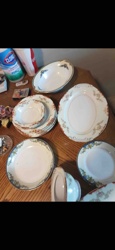
These notes were written by the person who submitted this item. Appraiser.AI has not verified them, and the AI's identification and estimate may rely on them.
AI Estimated Value
Not an official valuation
$25-40
AI estimate as of September 29, 2025 · verify with a professional before acting
AI-Generated · Verify before acting
Everything on this page is generated by AI for informational purposes only. AI can make mistakes — the AI may misidentify items or misattribute them (artist, maker, brand, designer, origin, era). This is not an official valuation and should not be used for insurance, sale, tax, estate, legal, or lending purposes — or any decision requiring a certified appraisal. It is not an authoritative claim about any person, brand, or rights holder — do not share or rely on it as a factual statement about a third party. Always consult qualified professionals before making financial decisions.
This analysis also relies on unverified notes provided by the user, which may be incomplete or inaccurate and could affect the result.
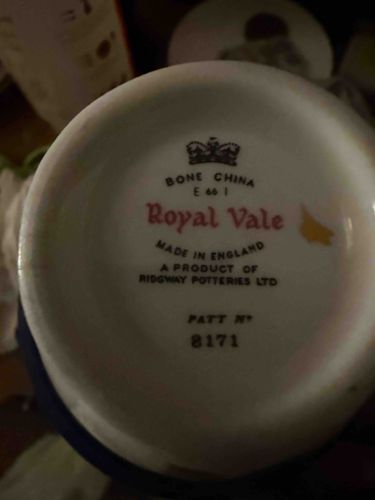
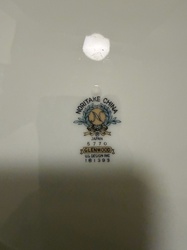
The item is identified as the base of a ceramic cup, likely part of a teacup set, given the 'Royal Vale' branding commonly associated with fine china tea wares. The visible base is off-white, consistent with bone china, which is known for its translucence and durability. The construction appears to be a standard molded form, characteristic of mass-produced yet high-quality porcelain. The central feature is the manufacturer's backstamp, which clearly states 'BONE CHINA' and features a crown motif, indicating its quality and origin. Below this, 'Royal Vale' is printed in a stylized pink script. Further details include 'E 66 1', possibly a date code or internal factory mark, and 'MADE IN ENGLAND', confirming its country of manufacture. The stamp also states 'A PRODUCT OF RIDGWAY POTTERIES LTD', identifying the larger pottery group. Finally, the pattern number 'PATT N° 8171' is prominent, which is crucial for identifying the specific design or series to which this cup belongs. The visible surface of the base appears clean with no obvious chips, cracks, or significant wear, though the lighting makes it difficult to assess minor surface abrasions or crazing. The overall impression is one of good condition, aligning with the quality expected from English bone china manufacturers.
AI Appraisal Report
I have examined the provided image of the Royal Vale Bone China cup base, Pattern 8171, and taken into account the owner's note about possessing a matching tea plate in perfect condition. Based on this, my appraisal is as follows:
The visible base of the cup, identified by its 'Royal Vale Bone China' backstamp and 'MADE IN ENGLAND' mark, appears to be in very good condition. The presence of 'A PRODUCT OF RIDGWAY POTTERIES LTD' further authenticates its origin and quality. The pattern number 'PATT N° 8171' is crucial for potential identification of the full pattern. The 'E 66 1' mark likely indicates a production batch or date code. Authenticity appears readily verifiable through the clear and well-preserved backstamp, consistent with known Royal Vale hallmarks. However, a physical inspection would be necessary to confirm the absence of subtle defects like hairline cracks, crazing (fine surface cracks in the glaze), significant knife marks on the tea plate, or any repairs not visible in the provided image. The overall impression is good, aligning with typical bone china quality.
Royal Vale bone china, while respected, is generally considered mid-range in the collectibles market. Cups and saucers, and trios (cup, saucer, and tea plate), are relatively common. Demand is steady but not typically high, unless a particular pattern is rare or highly sought after, which Pattern 8171 doesn't immediately suggest without further research into the specific decoration. Market comparables for similar Royal Vale cup and saucer or trio sets in excellent condition typically range from $20 to $50, depending on the pattern's popularity and dealer. The condition of the matching tea plate is a positive factor. Factors impacting value include the completeness of the set (a 'trio' typically includes a cup, saucer, and tea plate), the specific decorative pattern (which isn't visible here), and the overall condition. The lack of visual information on the decorative pattern itself is a significant limitation in definitively assessing rarity and specific market demand. Without seeing the actual design, and assuming it's a standard floral or decorative pattern, the value aligns with common examples of this type of English bone china.
For full authentication and a more precise valuation, a physical examination of both pieces (cup and tea plate) would be required to assess the decorative pattern, confirm the absence of any subtle damage or repairs, and gauge the overall 'shelf appeal' of the complete set.