AI estimate as of September 29, 2025 · verify with a professional before acting
AI-Generated · Verify before acting
Everything on this page is generated by AI for informational purposes only. AI can make mistakes — the AI may misidentify items or misattribute them (artist, maker, brand, designer, origin, era). This is not an official valuation and should not be used for insurance, sale, tax, estate, legal, or lending purposes — or any decision requiring a certified appraisal. It is not an authoritative claim about any person, brand, or rights holder — do not share or rely on it as a factual statement about a third party. Always consult qualified professionals before making financial decisions.
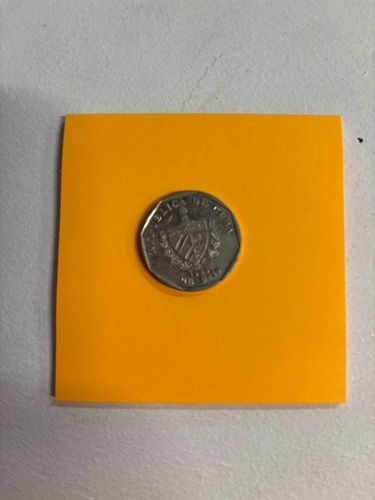
The item is a circulating coin, specifically a 50 Centavos piece from the Dominican Republic, displayed on an orange square background. The coin appears to be made of a silver-colored metal, likely copper-nickel or a similar alloy, consistent with modern coinage. Its physical characteristics include a circular shape with a reeded edge, though the edge detail is not clearly visible in this image. The obverse side of the coin, which is visible, features the national coat of arms of the Dominican Republic prominently in the center. This crest depicts a shield flanked by olive and palm branches, with a ribbon below bearing the national motto, 'Dios, Patria, Libertad' (God, Homeland, Liberty). Above the shield, a cross is visible, and behind it, four Dominican Republic flags. Around the upper periphery of the coin, the inscription 'REPUBLICA DOMINICANA' is partially visible, indicating its country of origin. Below the coat of arms, a date is present, but it is not clearly legible due to the resolution of the image and potential wear. The coin exhibits a circulated condition, with some areas of visible wear on the raised elements of the coat of arms and the lettering, suggesting it has been in active use. There might be some minor surface scratches or blemishes typical of used currency, but no significant damage like heavy dents or deep gouges is discernible. The overall patina is consistent with an aged but not heavily corroded metallic coin. The craftsmanship appears to be standard for mass-produced coinage, with clear but not exceptionally intricate detailing.
AI Appraisal Report
I have examined the provided image of what appears to be a Dominican Republic 50 Centavos coin. Based on its circulated condition, typical of modern coinage, and the visible wear on the obverse, I assess its authenticity as likely genuine for its intended purpose as circulating currency. The design, featuring the national coat of arms and 'REPUBLICA DOMINICANA,' aligns with standard issues from the country. This coin appears to be made of a base metal alloy, common for contemporary circulating denominations.
Market conditions for such a coin are generally low. These are mass-produced coins, and unless it's a rare date, a special commemorative issue (which this doesn't appear to be), or in uncirculated condition, their numismatic value rarely exceeds their face value significantly. This particular piece shows wear, further limiting its appeal to collectors. Demand for common, circulated foreign coinage is typically minimal, often traded only as part of larger collections or for very modest sums by beginner collectors. Rarity is not a factor here; these 50 Centavos coins from the Dominican Republic are quite common.
Factors impacting value include its circulated state, the lack of any discernible rare features, and its base metal composition. The specific date, which is unreadable in the image, could slightly influence value if it happened to be a known low-mintage year, but this is unlikely to drastically change the overall appraisal for a circulated example. My valuation reflects its intrinsic metal value (if any, though negligible for base metals) and a very slight premium for a collector if it were in better condition.
It is crucial to note that this authenticity assessment is based entirely on visual examination of an image. For full authentication, I would require a physical in-hand examination to assess weight, diameter, thickness, edge characteristics, and metallurgical properties. Microscopic analysis could reveal details not visible here, and provenance documentation would confirm its history. Scientific testing, such as XRF, would definitively determine its metallic composition.