AI Appraisal Estimate

AI-generated estimates · not official valuations

From the user

What was submitted

Photo and notes provided by the user — not generated by AI

Submitted item photo
Submitted photo · June 14, 2026

User's notes

Picture

AI analysis below

AI appraisal

AI analysis & estimate

AI-Generated · Verify before acting

Everything below is generated by AI for informational purposes only. AI can make mistakes — the AI may misidentify items or misattribute them (artist, maker, brand, designer, origin, era). This is not an official valuation and should not be used for insurance, sale, tax, estate, legal, or lending purposes — or any decision requiring a certified appraisal. It is not an authoritative claim about any person, brand, or rights holder — do not share or rely on it as a factual statement about a third party. Always consult qualified professionals before making financial decisions.

Note

This analysis also relies on unverified notes provided by the user, which may be incomplete or inaccurate and could affect the result.

Read the full disclaimer

AI Identification

·Not independently authenticated·Verify before acting

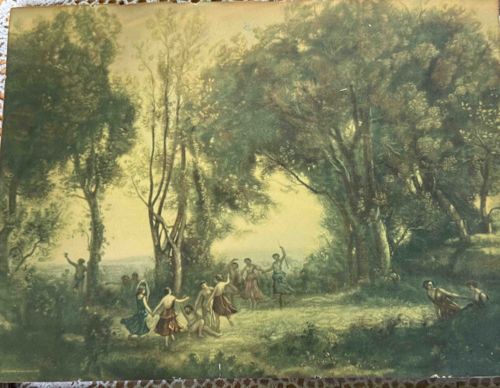
Pastoral Scene with Dancing Figures Print

Art Print

AI Estimated Value

·Not an official valuation·Verify before acting

$50 - $150

As of June 14, 2026

AI Item Analysis

·AI can make mistakes·Verify before acting
This item is a historical print depicting a pastoral scene featuring several dancing figures amidst a lush woodland. The composition is horizontally oriented and shows a clearing surrounded by tall, verdant trees with dense canopies suggesting a summer or late spring setting. The colors are predominantly muted greens and yellows, with some earthy browns and hints of blue or teal in the dancers' attire. The overall tone is somewhat subdued, likely due to age and potential fading, giving it an antique aesthetic. Several figures, seemingly young men and women, are depicted in various stages of a dance, some with arms raised or intertwined, suggesting a festive or ritualistic gathering. Their clothing appears to be ancient Greek or Roman in style, with draped garments. One figure on the far left has an arm raised, while a group of dancers occupies the central mid-ground. On the right, two figures are visible near a slight rise in the terrain. The printing method appears to be a chromolithograph or a similar multi-color printing technique, characterized by a somewhat grainy texture typical of prints from the late 19th or early 20th century. There are visible signs of aging and wear including discolored edges, minor creases or indentations, and a general softening of the image details, possibly from exposure to light or moisture. A subtle texture, possibly from the paper or the printing process itself, is visible across the surface. The edges of the print show some degradation, indicating it may have been removed from a frame or album, or handled extensively. There are no clear visible artist signatures or publisher marks in the provided images, which would be crucial for a definitive identification and valuation. The style is reminiscent of romanticized classical themes popular during the Rococo or Neoclassical revivals, but applied to a mass-produced print format.

AI Appraisal Report

·AI can make mistakes·Verify before acting
Upon examining the provided image of the 'Pastoral Scene with Dancing Figures' print, I assess its condition as Fair to Poor. There are clear indications of significant aging, including discolored edges, minor creases or indentations, and a general softening of image details, consistent with exposure to light and/or moisture. The muted colors and somewhat grainy texture suggest a chromolithograph or similar multi-color printing technique from the late 19th or early 20th century. The wear on the edges suggests extensive handling or removal from a frame/album. Authenticity, as a historical print rather than a fine art original, is generally supported by its style and apparent age. The classical themes were quite popular in mass-produced prints of that era. However, the absence of any visible artist signatures or publisher marks significantly limits a definitive assessment of its exact origin or authentication beyond a generic 'antique print' classification. Market conditions for unframed, unauthenticated chromolithographs of this type are generally modest. Comparables would include similar decorative prints from the late 19th/early 20th century, often found in antique shops or online marketplaces. Demand is typically driven by decorative appeal rather than artistic merit or rarity, unless a prominent artist or publisher can be identified. This specific print lacks any discernible characteristics that would suggest high rarity. Factors impacting its value negatively are its condition, lack of provenance, and the absence of identifying marks. Should it be linked to a known artist or publishing house, the value could increase, but without such information, it primarily holds decorative rather than significant investment value. In-person examination would be crucial to confirm the precise printing technique, paper quality, and to search for very faint or obscured marks. Scientific testing (e.g., pigment analysis) would be largely unwarranted for an item of this type unless a strong attribution to a significant artist emerged. Provenance documentation, such as original framing or family history, would undeniably enhance its value and authenticity claims.

Get your items appraised

Instant estimates of your treasures with AI-powered appraisals

Browse More Appraisals