AI estimate as of October 27, 2025 · verify with a professional before acting
AI-Generated · Verify before acting
Everything on this page is generated by AI for informational purposes only. AI can make mistakes — the AI may misidentify items or misattribute them (artist, maker, brand, designer, origin, era). This is not an official valuation and should not be used for insurance, sale, tax, estate, legal, or lending purposes — or any decision requiring a certified appraisal. It is not an authoritative claim about any person, brand, or rights holder — do not share or rely on it as a factual statement about a third party. Always consult qualified professionals before making financial decisions.
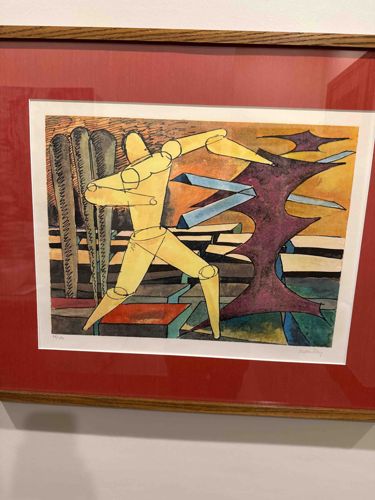
This item is a framed lithograph featuring an abstract, cubist-style artwork. The central figure is a yellow, jointed mannequin-like form, reminiscent of an artist's lay figure, depicted in a dynamic, almost attacking pose. Its limbs are segmented and articulated, casting a sense of movement. The background features a vibrant array of colors and geometric shapes, with a prominent dark purple, organically shaped, almost monstrous form on the right, which the yellow figure appears to be interacting with or confronting. To the left, there are vertical, textured elements that resemble trees or columns, while the mid-ground and foreground consist of geometric blocks and planes in various shades of blue, red, and brown, creating a sense of dimension and space. The print is signed by the artist in the bottom right corner, though the signature is not clearly legible from the image. It also has an edition number '136/350' in the bottom left, indicating it is a limited edition print. The color palette includes warm yellows and oranges contrasting with cooler blues and greens, and a deep purple, all rendered with distinct outlines typical of lithographic printing. The print is presented within a red mat board and a light brown wooden frame, which shows visible wood grain. The frame appears to be in good condition, as does the mat, with no visible fading or major damage to the print itself. The style suggests a mid-20th century to late-20th century aesthetic, influenced by Cubism and Surrealism, with clean lines and bold color blocking indicating good craftsmanship. Given the edition number, it is likely a mass-produced fine art print rather than an original painting, but the quality of the print appears high.
AI Appraisal Report
I have visually examined this framed lithograph, an Abstract Cubist Figure Confronting Form. The print depicts a dynamic yellow cubist figure interacting with a dark purple organic shape against a vibrant geometric background. The colors are bold with distinct outlines, consistent with high-quality lithographic printing. The print appears to be in very good condition with no visible fading, tears, or significant damage. The red mat board and light brown wooden frame also appear well-maintained. The presence of a clear edition number (136/350) and a visible, though illegible, signature confirms it as a limited edition fine art print, rather than an original painting. The style aligns with mid to late 20th-century Cubist and Surrealist influences.
Market conditions for unsigned fine art prints from unidentifiable artists, even limited editions, typically place them in a lower tier compared to pieces with established provenance or artist recognition. Without knowing the artist's name, demand is generally limited to those who appreciate the aesthetic appeal. The edition size of 350 is substantial, suggesting it is not particularly rare. Factors impacting value positively are its good condition and strong visual appeal. However, the lack of an identifiable artist significantly limits its potential market value.
My assessment for condition and authenticity is based solely on the provided image. For full authentication and a more precise valuation, an in-person examination would be critical to verify the printmaking technique, assess the paper quality, and confirm the signature's authenticity. Research into the artist, once identified, and their exhibition history and market performance would also be essential. Scientific testing might be needed if there were doubts about the print's age or materials.