AI Appraisal Estimate

AI-generated estimates · not official valuations

From the user

What was submitted

Photo and notes provided by the user — not generated by AI

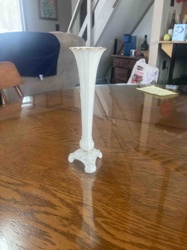
Submitted item photo
Submitted photo · June 8, 2026

User's notes

Made in Japan

AI analysis below

AI appraisal

AI analysis & estimate

AI-Generated · Verify before acting

Everything below is generated by AI for informational purposes only. AI can make mistakes — the AI may misidentify items or misattribute them (artist, maker, brand, designer, origin, era). This is not an official valuation and should not be used for insurance, sale, tax, estate, legal, or lending purposes — or any decision requiring a certified appraisal. It is not an authoritative claim about any person, brand, or rights holder — do not share or rely on it as a factual statement about a third party. Always consult qualified professionals before making financial decisions.

Note

This analysis also relies on unverified notes provided by the user, which may be incomplete or inaccurate and could affect the result.

Read the full disclaimer

AI Identification

·Not independently authenticated·Verify before acting

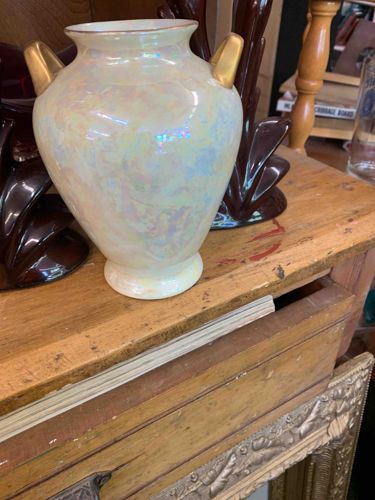
Iridescent Ceramic Lusterware Vase with Gold Handles

Decorative Arts/Ceramics

AI Estimated Value

·Not an official valuation·Verify before acting

$25 - $45

As of June 8, 2026

AI Item Analysis

·AI can make mistakes·Verify before acting
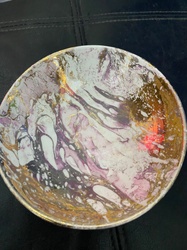
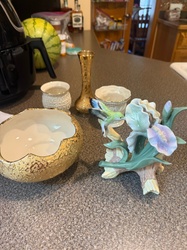
This is a vintage iridescent ceramic vase, likely made in Japan given the provided context. The vase features a classic amphora or urn-like shape, tapering from a wider body to a moderately flared lip at the top and a circular foot at the bottom. Its dominant characteristic is the pearlescent or 'lusterware' finish, which gives it an opalescent sheen with visible iridescent flashes of pink, blue, and green when viewed from different angles. The primary body color appears to be a creamy off-white or light ivory. Two small, decorative, upward-pointing handles are affixed just below the rim on opposite sides, finished in a metallic gold color, which also appears to be hand-painted along the rim. The ceramic material appears smooth and glazed, suggesting fine craftsmanship typical of decorative ceramics. There are no immediately visible chips, cracks, or significant damage, though some light wear or minor abrasions might be present on the surface consistent with its age. The gold trim on the handles and rim looks largely intact, without significant chipping or fading. No specific maker's marks or signatures are discernible from the provided images. Based on the iridescent finish and classic shape with stylized handles, this vase likely dates from the mid-20th century, possibly 1950s or 1960s, a period when lusterware was popular for decorative household items. Its quality is indicated by the consistent application of the iridescent glaze and the intact state of both the ceramic body and the gold accents.
AI Appraisal Report

·AI can make mistakes·Verify before acting
Upon examining the provided images of this Japanese iridescent lusterware vase, my assessment is as follows. The piece presents in very good vintage condition. The ceramic body appears free of significant chips, cracks, or repairs. The pearlescent glaze is consistent, displaying attractive iridescent qualities. The hand-painted gold accents on the handles and rim also appear largely intact, with minimal wear consistent with its age, likely dating to the mid-20th century (c. 1950s-1960s). This type of Japanese lusterware was produced in large quantities for the export market and is relatively common. While decorative and well-preserved, its value is primarily as a decorative collectible rather than a rare antique. The market for mid-century Japanese ceramics of this style is accessible, with similar items frequently available. Comparable lusterware vases from this era, without a specific high-end maker's mark, typically sell in the lower price range. The vase's excellent condition is its strongest value point, but its widespread availability limits its potential for a high valuation. It is important to note that this appraisal is based on images alone. A definitive authentication would require a physical examination to search for a maker's mark on the underside (such as Noritake, Maruyama, etc.), which could significantly alter the value. Without physical inspection or provenance, its specific origin and maker remain unconfirmed.

Get your items appraised

Instant estimates of your treasures with AI-powered appraisals

Browse More Appraisals