These notes were written by the person who submitted this item. Appraiser.AI has not verified them, and the AI's identification and estimate may rely on them.
AI Estimated Value
Not an official valuation
$30 - $70
AI estimate as of November 8, 2025 · verify with a professional before acting
AI-Generated · Verify before acting
Everything on this page is generated by AI for informational purposes only. AI can make mistakes — the AI may misidentify items or misattribute them (artist, maker, brand, designer, origin, era). This is not an official valuation and should not be used for insurance, sale, tax, estate, legal, or lending purposes — or any decision requiring a certified appraisal. It is not an authoritative claim about any person, brand, or rights holder — do not share or rely on it as a factual statement about a third party. Always consult qualified professionals before making financial decisions.
This analysis also relies on unverified notes provided by the user, which may be incomplete or inaccurate and could affect the result.
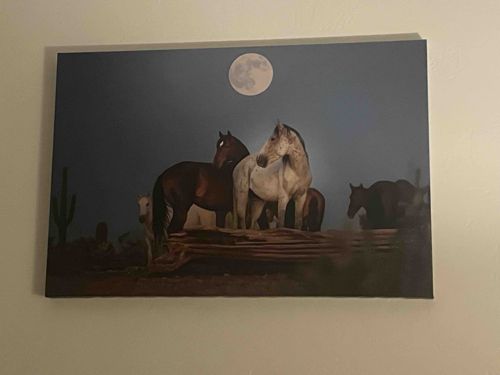
This is a new digital canvas print depicting a nocturnal scene of wild horses under a prominent full moon. The artwork features a group of horses, with at least two clearly visible in the foreground: a dark brown or bay horse and a lighter-colored, possibly dapple grey or cream-colored horse. These two horses appear to be standing on or behind a large fallen log or rocky outcrop, which runs horizontally across the midground. Several other horses are partially visible or silhouetted in the background, suggesting a larger herd. The background features a dark, deep blue sky, characteristic of nighttime, with the large, luminous full moon positioned centrally in the upper part of the canvas. To the left, a saguaro cactus is discernible, firmly placing the setting in a desert or arid landscape. The color palette is dominated by dark blues, browns, and grays, with the moon providing a stark contrast in pale yellow and white. The print exhibits clean lines and a smooth surface, indicating its 'new' condition as stated in the context. There are no apparent signs of wear, damage, fading, or repairs visible in the image. The edges of the canvas appear to be wrapped, providing a finished look. Given the context 'New digital canvas print', it is a modern reproduction, likely mass-produced, and not an original painting. The craftsmanship appears to be standard for digital prints on canvas, focusing on accurate color reproduction and a taut surface.
AI Appraisal Report
I have examined the provided image of the 'Wild Horses Under a Full Moon Canvas Print.' Based on this visual inspection and the proprietor's statement that it is a 'new digital canvas print,' my assessment of its condition is excellent, consistent with a new item. There are no visible signs of wear, damage, fading, or repairs. The image quality, color reproduction, and canvas tension appear standard for this type of modern reproduction. Authenticity, in the traditional art market sense, is not applicable here as it is a digital print, not an original artwork. Its authenticity lies in its truthful representation as a digital print on canvas, which it appears to be.
Market conditions for new digital canvas prints of popular themes like wildlife and landscapes are generally stable, with a wide array of options available from various online retailers and big-box stores. Comparable items, often mass-produced, typically retail for modest prices, depending on size and framing. Demand for such decorative pieces is driven by individual aesthetic preferences rather than investment potential. Rarity is not a factor here; this is a widely accessible product type.
Factors significantly impacting its value include its nature as a reproduction rather than an original artwork, the lack of artist provenance, and its likely mass-produced origin. Digital prints, while visually appealing, do not hold the same intrinsic or investment value as original paintings or limited-edition fine art prints. The value is primarily decorative.
Regarding limitations in authenticity verification: while I can confidently assess its condition as 'new' from the image, full authentication of the canvas material, ink quality, and exact printing process would necessitate in-person examination. However, for a digital print of this nature, such detailed examination is usually only relevant for verifying manufacturing quality standards rather than artistic authenticity or significant monetary value.