AI estimate as of August 6, 2025 · verify with a professional before acting
AI-Generated · Verify before acting
Everything on this page is generated by AI for informational purposes only. AI can make mistakes — the AI may misidentify items or misattribute them (artist, maker, brand, designer, origin, era). This is not an official valuation and should not be used for insurance, sale, tax, estate, legal, or lending purposes — or any decision requiring a certified appraisal. It is not an authoritative claim about any person, brand, or rights holder — do not share or rely on it as a factual statement about a third party. Always consult qualified professionals before making financial decisions.
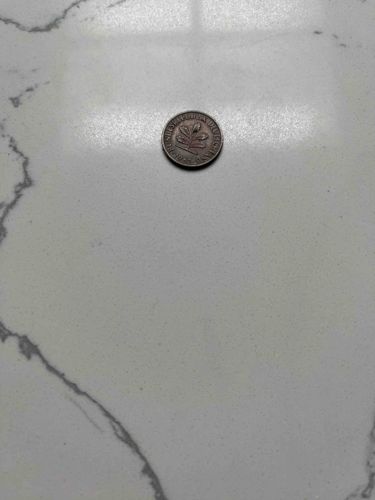
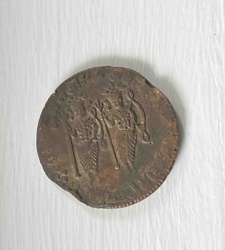
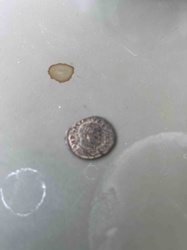
The item appears to be a metal coin, likely made of a copper alloy given its reddish-brown hue and visible patina. It is circular in shape with a raised rim on the obverse side visible in the image. The diameter is consistent with a standard circulating coin, possibly around 20-25mm. The surface exhibits a noticeable amount of wear, particularly on the raised elements of the design, indicating circulation over time. There is a distinct patina, which suggests an older age and is a natural oxidation process for copper or bronze. The central motif is a detailed depiction of what appears to be a maple leaf or a similar trifoliate leaf design, possibly symbolizing a country or region. Below the leaf, there's a large, stylized 'K' and 'V' or 'IV' which could represent a denomination or a specific mint mark. Around the edge, partially legible text is visible, with "REPUBLICA" and "DOMINICANA" clearly discernible, along with a date that appears to be "1937" or "1934". The overall craftsmanship suggests it was produced in a professional minting facility. The condition suggests significant handling, with some loss of fine detail and likely a dulling of the original luster. No overt damage such as significant scratches or bends are visible, but the wear is consistent with a coin that has been in circulation for many decades. The edges appear reeded or milled, a common security feature on coins. The specific markings point to it being a circulating currency of the Dominican Republic, likely from the mid-20th century.
AI Appraisal Report
Based on my visual examination of the provided image, I can offer the following appraisal. The coin, identified as a Dominican Republic issue, likely from 1934 or 1937, appears authentic for that period. Its reddish-brown hue and visible patina are consistent with a copper or bronze composition and typical aging for coins of this era. The wear evident, particularly on raised elements like the central leaf motif and the "K" and "V" (possibly a denomination or mintmark interpretation), indicates significant circulation. This wear, while common for older currency, detracts from its numismatic grade. The legibility of "REPUBLICA DOMINICANA" and the date (1934 or 1937) aids in identification. The reeded edge, though not fully clear, is typical for security in coinage.
In terms of market conditions, Dominican Republic coins from the 1930s, especially lower denominations, are generally quite common. Their value largely depends on condition and specific mintage figures. Coins in circulated condition like this one typically have a more modest value compared to uncirculated examples. There is a steady, but not exceptionally high, demand for world coins from this period among collectors. Rarity is not a major factor for standard circulating issues unless a specific variety or error is present, which is not discernible from the image. The most significant factor impacting its value negatively is the advanced state of wear.
My appraisal is limited by the visual input; I cannot definitively verify authenticity without a physical examination. I would need to observe the coin’s weight, precise diameter, edge characteristics, and surface details under magnification to confirm authenticity beyond doubt. Furthermore, spectral analysis could confirm metal composition, and provenance documentation, if available, would further secure its historical accuracy and chain of ownership. Without these, I must rely solely on the visible attributes.