Japanese Blue and White 'Phoenix' Porcelain Creamer
Asian Antique/Vintage Ceramics

Japanese Blue and White 'Phoenix' Porcelain Creamer

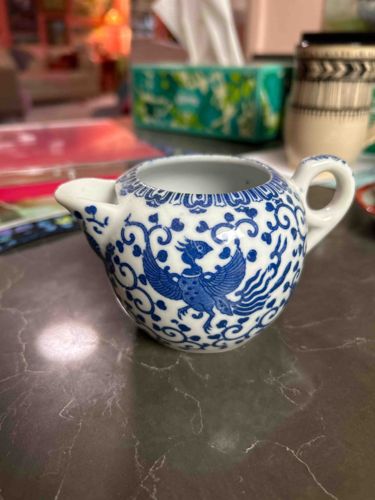
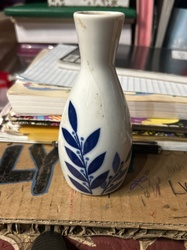
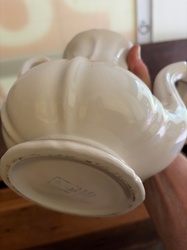
This is a small, bulbous porcelain creamer featuring the traditional Japanese 'Hō-ō' (Phoenix) motif, also commonly known in export markets as the 'Flying Turkey' pattern. The piece is constructed from high-fired white porcelain with a blue underglaze transfer-ware decoration. Physically, the item exhibits a squat, rounded body with a small loop handle and a short, pinched pouring spout. The central motif depicts a stylized phoenix with outstretched wings, surrounded by dense scrolling arabesque vines (karakusa) and floral elements. A repeating geometric lotus petal or ruyi border encircles the rim. The color is a classic cobalt blue against a bright white ground, typical of 20th-century Japanese output for both domestic use and export. Based on the style and execution, this piece likely dates from the Showa era (approx. mid-20th century). The craftsmanship shows standardized production quality, typical of regional kilns in Seto or Arita. In terms of condition, the porcelain appears structurally sound with no visible cracks or large chips on the exterior body. The glaze retains a high gloss, though slight pitting or 'pinholes'—a common manufacturing artifact in mass-produced Japanese porcelain—may be present upon close inspection. The base (not visible but inferred) likely features a circular unglazed foot ring and potentially a 'Made in Japan' or 'Nippon' backstamp, though the lack of a seen mark suggests it may be part of a larger, unmarked set.
Estimated Value

$15.00 - $35.00

Basic Information

Category

Asian Antique/Vintage Ceramics

Appraised On

March 29, 2026

Estimated Value

$15.00 - $35.00

Additional Details Provided By Owner

User Provided Information

small japanese creamer porcelain

Item Description

This is a small, bulbous porcelain creamer featuring the traditional Japanese 'Hō-ō' (Phoenix) motif, also commonly known in export markets as the 'Flying Turkey' pattern. The piece is constructed from high-fired white porcelain with a blue underglaze transfer-ware decoration. Physically, the item exhibits a squat, rounded body with a small loop handle and a short, pinched pouring spout. The central motif depicts a stylized phoenix with outstretched wings, surrounded by dense scrolling arabesque vines (karakusa) and floral elements. A repeating geometric lotus petal or ruyi border encircles the rim. The color is a classic cobalt blue against a bright white ground, typical of 20th-century Japanese output for both domestic use and export. Based on the style and execution, this piece likely dates from the Showa era (approx. mid-20th century). The craftsmanship shows standardized production quality, typical of regional kilns in Seto or Arita. In terms of condition, the porcelain appears structurally sound with no visible cracks or large chips on the exterior body. The glaze retains a high gloss, though slight pitting or 'pinholes'—a common manufacturing artifact in mass-produced Japanese porcelain—may be present upon close inspection. The base (not visible but inferred) likely features a circular unglazed foot ring and potentially a 'Made in Japan' or 'Nippon' backstamp, though the lack of a seen mark suggests it may be part of a larger, unmarked set.
Get Your Items Appraised

Instant estimates of your treasures with AI-powered instant appraisals

Browse More Appraisals