These notes were written by the person who submitted this item. Appraiser.AI has not verified them, and the AI's identification and estimate may rely on them.
AI Estimated Value
Not an official valuation
$1,200 - $1,800
AI estimate as of September 27, 2025 · verify with a professional before acting
AI-Generated · Verify before acting
Everything on this page is generated by AI for informational purposes only. AI can make mistakes — the AI may misidentify items or misattribute them (artist, maker, brand, designer, origin, era). This is not an official valuation and should not be used for insurance, sale, tax, estate, legal, or lending purposes — or any decision requiring a certified appraisal. It is not an authoritative claim about any person, brand, or rights holder — do not share or rely on it as a factual statement about a third party. Always consult qualified professionals before making financial decisions.
This analysis also relies on unverified notes provided by the user, which may be incomplete or inaccurate and could affect the result.
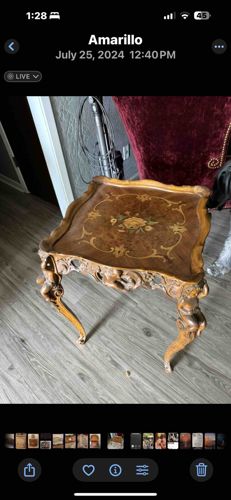
This is an exquisitely crafted occasional table, likely Italian in origin, distinguished by its intricate marquetry top and heavily carved wooden base. The table features a shaped, possibly scalloped, tray-style top with a raised edge, made from rich, warm-toned wood, possibly walnut or burl wood veneer. The central panel of the tabletop boasts a detailed floral marquetry inlay, depicting what appears to be roses and foliage in lighter woods, contrasting beautifully with the darker ground. The colors used in the inlay include yellows, greens, and browns, providing a subtle yet elegant decoration. The base of the table is particularly ornate, featuring heavily carved cabriole legs adorned with volutes, acanthus leaves, and what appear to be figural elements, possibly cherubic or grotesque masks, at the upper junctions where they meet the frame. The carving is deep and detailed, showcasing skilled craftsmanship. The overall style suggests a Baroque or Rococo influence, possibly dating from the late 19th to early 20th century, though it could be a later revival piece. The wood shows a rich patina consistent with age, with some visible wear and minor surface abrasions, particularly on the legs and edges, indicating its use over time. No significant damage or repairs are immediately apparent, but a closer inspection would be needed to confirm. The table's construction appears solid, pointing to a high-quality piece of furniture designed to be both decorative and functional. The complex carving and marquetry are indicators of sophisticated artisan work.
AI Appraisal Report
Based on my visual examination of the provided image, this Italian Marquetry and Carved Wood Occasional Table appears to be a well-crafted piece exhibiting Baroque or Rococo revival characteristics. The intricate floral marquetry on the top, featuring delicate roses and foliage in contrasting lighter woods against a darker ground, indicates skilled artisan work. The heavily carved cabriole legs, adorned with volutes, acanthus leaves, and figural elements, further underscore its decorative appeal and craftsmanship. The rich patina is consistent with a piece from the late 19th to early 20th century. I observe some visible wear, minor surface abrasions, and subtle fading, particularly on the edges and legs, which is expected for an item of this age and consistent with regular use. The overall construction appears solid, suggesting quality. While the owner's mention of 'camel saddle bags and woven' is noted, it doesn't directly influence the table's appraisal unless they were part of its historical provenance or original setting, which isn't indicated.
In terms of market conditions, demand for well-preserved, ornate period revival furniture remains steady, though not at peak historical levels. Pieces with exceptional marquetry and carving, like this one, command higher prices than simpler examples. Comparables include other Italian or French Rococo/Baroque-style occasional tables from the late Victorian or early 20th century. Its artistic complexity and apparent good condition contribute positively to its value. The intricacy of both marquetry and carving suggests a higher-end production, impacting its rarity positively.
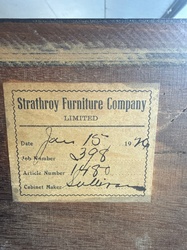
Factors significantly impacting its value include the evident craftsmanship, the intact marquetry design, and the overall aesthetic appeal. Without physical inspection, I cannot definitively confirm the wood species (e.g., walnut or burl veneer), the exact age, or rule out any professional repairs or structural weaknesses. An in-person examination would allow for a tactile assessment of carving detail, verification of veneer condition, and a thorough inspection for discrete repairs or structural integrity issues. Furthermore, provenance documentation detailing its history of ownership or manufacturing origin would significantly aid in full authentication and potentially enhance value.