AI estimate as of October 17, 2025 · verify with a professional before acting
AI-Generated · Verify before acting
Everything on this page is generated by AI for informational purposes only. AI can make mistakes — the AI may misidentify items or misattribute them (artist, maker, brand, designer, origin, era). This is not an official valuation and should not be used for insurance, sale, tax, estate, legal, or lending purposes — or any decision requiring a certified appraisal. It is not an authoritative claim about any person, brand, or rights holder — do not share or rely on it as a factual statement about a third party. Always consult qualified professionals before making financial decisions.
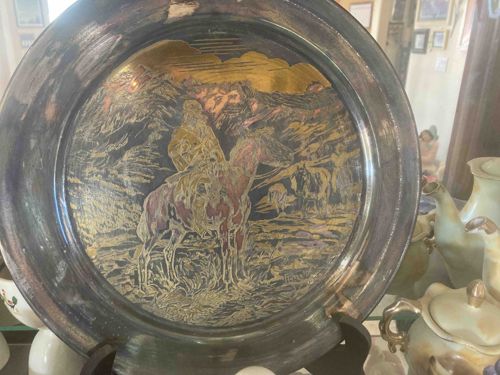
This is a round, decorative metal plate, likely intended for display rather than functional use. The primary material appears to be a dark-toned metal, possibly copper, brass, or a plated alloy, presenting with a somewhat tarnished or aged silver-like patina around the rim and background areas of the central design. The plate features an intricate etched or engraved scene, with elements then highlighted through gilding, primarily in gold and reddish-brown hues. The central motif depicts a figure, possibly a person, riding a camel or similar dromedary animal. The background illustrates a mountainous landscape beneath what appears to be a stylized sky or clouds, all rendered with similar etched lines and gilding. The gold and reddish accents suggest a rich, almost regal aesthetic against the darker base metal. Visible condition issues include significant tarnishing and discoloration, particularly on the outer rim and in some of the darker etched areas, contributing to an antique appearance. There are also several light scratches or scuff marks, consistent with age and handling. The craftsmanship suggests a process involving etching to create the detailed lines, followed by the application of gold-colored and reddish-brown gilding, possibly through a damascening or acid-etching and plating technique. No clear manufacturer's marks or signatures are immediately discernible from the provided image. The style and motif suggest an item originating from the Middle East, North Africa, or an area influenced by these cultures, possibly from the late 19th to mid-20th century, given the prevalent use of such decorative metalwork during that period. The plate has a raised rim, typical of decorative charger plates.
AI Appraisal Report
I have examined the provided image of the Etched and Gilded Metal Decorative Plate with Camel Rider Motif. Based on visual assessment, the item appears to be an authentic decorative metal plate, likely from the Middle East or North Africa, consistent with late 19th to mid-20th century craftsmanship. The decorative elements, including the camel rider motif, mountainous landscape, and stylized sky, are rendered through etching and highlighted with what appears to be gilding in gold and reddish-brown hues. The plate exhibits a raised rim, typical of decorative chargers.
From the image, the condition shows significant tarnishing and discoloration, especially on the outer rim and in the darker etched areas, which is consistent with age and contributes to an antique aesthetic. Several light scratches and scuff marks are also visible, suggesting normal wear and handling over time. These condition issues, while present, do not severely detract from the overall decorative appeal for collectors of such items, as they are often expected with age.
In terms of market conditions, similar etched and gilded Orientalist decorative plates, especially those from the mentioned period without clear artist signatures or prestigious provenance, typically fetch modest prices. Demand for such items is steady but not exceptionally high unless there are unique historical connections or superior artistic execution. Rarity is limited as many such decorative items were produced.
Factors significantly impacting value include the lack of a discernible maker's mark or signature, preventing attribution to a known artisan or workshop. The primary material, whether solid copper/brass or a plated alloy, cannot be definitively determined from the image, which impacts intrinsic value. The quality and durability of the gilding also play a role, but visual assessment is limited. For full authentication and a more precise valuation, an in-person examination would be crucial to confirm the metal composition, the exact technique of embellishment (e.g., true gilding vs. painted details), and to search for any faint marks not visible in the image. Provenance documentation, if available, would also significantly enhance its value by establishing its origin and history.