AI Appraisal Estimate

AI-generated estimates · not official valuations

From the user

What was submitted

Photo and notes provided by the user — not generated by AI

Submitted item photo
Submitted photo · May 30, 2026

User's notes

Boston Harbor Teapot With Eagle Shield

AI analysis below

AI appraisal

AI analysis & estimate

AI-Generated · Verify before acting

Everything below is generated by AI for informational purposes only. AI can make mistakes — the AI may misidentify items or misattribute them (artist, maker, brand, designer, origin, era). This is not an official valuation and should not be used for insurance, sale, tax, estate, legal, or lending purposes — or any decision requiring a certified appraisal. It is not an authoritative claim about any person, brand, or rights holder — do not share or rely on it as a factual statement about a third party. Always consult qualified professionals before making financial decisions.

Note

This analysis also relies on unverified notes provided by the user, which may be incomplete or inaccurate and could affect the result.

Read the full disclaimer

AI Identification

·Not independently authenticated·Verify before acting

Historical Flow Blue 'Boston Harbor' Teapot with Eagle Shield

Antique Ceramics and Pottery

AI Estimated Value

·Not an official valuation·Verify before acting

$400 - $600

As of May 30, 2026

AI Item Analysis

·AI can make mistakes·Verify before acting
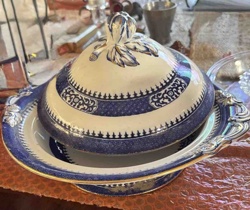
This is a significant piece of historical transferware, specifically a teapot featuring the 'Boston Harbor' pattern, often associated with the 'Eagle Shield' series. The teapot showcases a deep, saturated Flow Blue glaze characteristic of 19th-century Staffordshire pottery. Measuring approximately 7 to 9 inches in height (compared to the adjacent water bottle), it is constructed of ironstone or earthenware. The form includes an ornate, C-curved handle with thumb rest, a gadrooned or lobed body, and a matching domed lid with a decorative finial. The central transfer-printed motif depicts a maritime scene of Boston Harbor, surrounded by floral borders and American eagle emblems within shields, signaling its production for the American market during the mid-1800s. The glaze flow is pronounced, creating a blurred, atmospheric aesthetic. Condition-wise, the image reveals significant visible damage: substantial glaze loss and chipping are evident on the lower pedestal base and along the body's lower portion, exposing the white clay body beneath. A possible repair or crack may be present near the spout's junction to the body. Despite the wear, the craftsmanship is high, reflecting the industrial artistry of the Victorian era.
AI Appraisal Report

·AI can make mistakes·Verify before acting
Based on my examination of the provided imagery, this teapot is an authentic 19th-century Staffordshire Flow Blue piece, likely produced by John Ridgway or a similar prominent manufactory targeting the American export market circa 1840-1860. The 'Boston Harbor' pattern, combined with the patriotic Eagle Shield motif, places this in a desirable category of Historical Staffordshire known as the 'American Scene' series. The deep cobalt saturation is classic 'Flow Blue,' where the pigment intentionally bleeds into the glaze, achieving that sought-after hazy, atmospheric quality. The lobed body and decorative finial attest to high-quality Victorian molding. However, value is heavily impacted by condition. I observe significant damage to the foot rim and lower body, with substantial glaze loss and ceramic dislocation exposing the white earthenware body. The potential crack near the spout further compromises structural integrity. In excellent condition, a piece of this rarity and subject matter could command prices upwards of $1,200-$1,500. Unfortunately, the restoration costs to bring this to museum quality would likely exceed the increase in value. Consequently, I am valuing this primarily as a study piece or cabinet filler for a serious collector who prioritizes the rare pattern over perfection. To confirm the specific maker, I would need to physically inspect the underside for maker's marks or impressed codes, which are not visible here. UV light testing would also be required to identify if existing adhesives are present in the suspected repairs.

Get your items appraised

Instant estimates of your treasures with AI-powered appraisals

Browse More Appraisals