AI estimate as of July 25, 2025 · verify with a professional before acting
AI-Generated · Verify before acting
Everything on this page is generated by AI for informational purposes only. AI can make mistakes — the AI may misidentify items or misattribute them (artist, maker, brand, designer, origin, era). This is not an official valuation and should not be used for insurance, sale, tax, estate, legal, or lending purposes — or any decision requiring a certified appraisal. It is not an authoritative claim about any person, brand, or rights holder — do not share or rely on it as a factual statement about a third party. Always consult qualified professionals before making financial decisions.
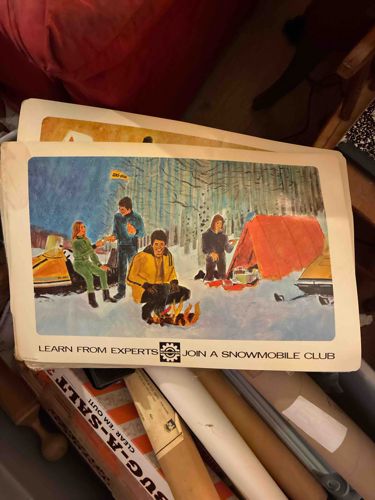
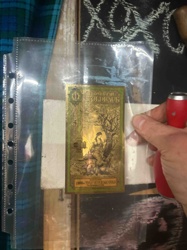
This item is a vintage pamphlet or booklet, likely an informational or promotional piece, featuring a colorful illustration on its cover. The cover art depicts a group of four individuals gathered around a campfire in a snowy, wooded winter setting, indicative of a snowmobiling excursion. Two snowmobiles, one yellow and one orange, are partially visible on either side of the scene. The overall color palette is cool, with dominant blues and whites for the snow and sky, contrasted by warm earth tones for the figures' clothing (e.g., a yellow jacket) and the orange tent and campfire. The illustration style suggests an mid-20th century, possibly 1960s or 1970s, aesthetic, characterized by bold outlines and a somewhat graphic, less photorealistic approach. The print is on paper or light cardstock, exhibiting some light wear and aging, including slight discoloration and minor creasing along the edges, consistent with its age and handling. There's a subtle fold or crease visible near the bottom left corner, and the edges appear slightly softened. The bottom edge of the cover features a slogan: "LEARN FROM EXPERTS" on the left, an emblem resembling a gear or sprocket in the center, and "JOIN A SNOWMOBILE CLUB" on the right. The visible emblem is a black square with a white gear-like design inside. This implies the item is promoting snowmobiling safety or community involvement. The back of the item is not visible, but the presence of other similar-looking items underneath suggests it's part of a collection or series. The item's condition indicates it has been stored but retains its central visual appeal.
AI Appraisal Report
Based on my visual examination of the provided image, this Vintage Snowmobile Club Promotional Pamphlet appears to be an authentic piece of mid-20th century advertising ephemera. The graphic style, particularly the illustration with bold outlines and a less photographic approach, strongly suggests a 1960s or 1970s origin, consistent with the era of snowmobiling's burgeoning popularity. Its condition, showing light wear, subtle discoloration, and minor creasing, aligns with natural aging and handling for an item of this type and age. The "LEARN FROM EXPERTS, JOIN A SNOWMOBILE CLUB" slogan, coupled with the gear emblem, clearly indicates its promotional and informational purpose for a snowmobile club.
In terms of market conditions, vintage snowmobiling ephemera, while niche, does have a dedicated collector base, especially those interested in recreational history, graphic design from the period, or snowmobile brands. Comparables would typically include similar promotional pamphlets, brochures, or club materials from the same era by other clubs or manufacturers. Items featuring strong, illustrative graphics tend to perform better than plain text.
The demand for this specific piece would likely be moderate. Its rarity is difficult to ascertain without knowing how many were produced or how many have survived. Given its promotional nature, it was likely produced in quantity but, being paper ephemera, many would have been discarded. Factors impacting value include the appealing cover art, its good overall condition despite minor wear, and its clear historical context. The implied suggestion of being part of a series could slightly enhance its appeal to collectors aiming for completion.
My primary limitation in this appraisal is the lack of physical examination. While the visual indicators of authenticity are strong, a hands-on inspection would allow for confirmation of paper stock, printing method, exact dimensions, and a more precise assessment of condition, including any tears, repairs, or hidden flaws not visible in the image. Provenance (e.g., source of acquisition) would also add significant layers of authentication. Without direct examination, I cannot definitively rule out modern reproduction, though the aging visible appears consistent with genuine vintage wear.