AI estimate as of December 9, 2025 · verify with a professional before acting
AI-Generated · Verify before acting
Everything on this page is generated by AI for informational purposes only. AI can make mistakes — the AI may misidentify items or misattribute them (artist, maker, brand, designer, origin, era). This is not an official valuation and should not be used for insurance, sale, tax, estate, legal, or lending purposes — or any decision requiring a certified appraisal. It is not an authoritative claim about any person, brand, or rights holder — do not share or rely on it as a factual statement about a third party. Always consult qualified professionals before making financial decisions.
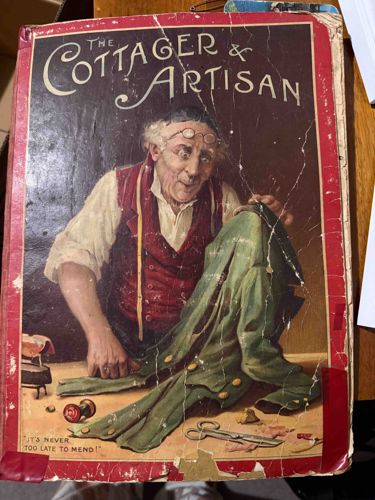
This item is an antique or vintage bound periodical or magazine titled "The Cottager & Artisan." The front cover features a colorful illustration depicting an elderly man, likely a tailor or artisan, with round spectacles perched on his nose, intently working on a green garment with brass-colored buttons. He is wearing a white shirt and a red waistcoat with yellow suspenders. On the table beside him are various sewing implements including a small iron, a spool of red thread, some loose buttons, and a pair of scissors. Below the illustration, a caption reads, "IT'S NEVER TOO LATE TO MEND!" The title "THE COTTAGER & ARTISAN" is prominently displayed at the top in decorative serif font. The overall color scheme of the cover is rich, with a dark background for the title and illustration, framed by a wide red border.
The physical condition of the cover is visibly worn, suggesting considerable age and use. There are numerous creases, cracks, and areas where the surface paper or protective layer has flaked off, particularly noticeable across the illustration and along the edges. The red border shows significant chipping and fraying, especially at the bottom and corners. The binding edge (to the left of the image) appears to be discolored and also shows signs of wear, suggesting a softcover or a previously bound volume that has seen better days. The colors of the illustration, while still discernible, have likely faded to some extent and are obscured by the surface damage. The item appears to be a single issue or a collection of issues bound together, characteristic of late 19th or early 20th-century publications aimed at a domestic or working-class audience, possibly offering practical advice, stories, or craft instructions. The craftsmanship of the original printing is evident in the detailed illustration, typical of period lithography or similar printing techniques.
AI Appraisal Report
I have examined the provided image of 'The Cottager & Artisan' periodical. Based on the visual evidence, this appears to be a genuine late 19th or early 20th-century publication, consistent with the style of illustration and typography of that era. The 'IT'S NEVER TOO LATE TO MEND!' caption further supports its likely audience and content focus on domestic arts or working-class themes.
The condition is a significant factor in valuation. The cover exhibits heavy wear, including numerous creases, cracks, flaking, chipping, and fraying, particularly noticeable on the red border and across the illustration. The binding edge also shows discoloration and wear. This severe condition significantly detracts from its aesthetic appeal and structural integrity, placing it firmly in the 'poor' to 'fair' category.
Periodicals of this type, especially in this condition, generally have a modest market value. While there's a niche market for antique periodicals, particularly those with charming illustrations or historical significance, the demand for single issues or heavily worn bound volumes of 'The Cottager & Artisan' is moderate. Rarity is not exceptionally high for such publications unless they contain particularly notable articles or illustrations.
Factors impacting value: The charming cover art provides some collectibility, but the poor condition is the primary detractor. Without knowing the exact date, contents (illustrations, articles), or if it's a complete volume or single issue, a precise valuation is difficult.
Limitations: Authenticity verification from an image alone is limited. I can confirm it appears period-correct. For full authentication and a more precise appraisal, I would need a physical examination to assess the paper quality, printing technique, internal completeness, confirm binding (original vs. later), and check for any internal damage or repairs not visible here. Provenance documentation, such as where it was acquired or its ownership history, would also be beneficial.