AI estimate as of October 23, 2025 · verify with a professional before acting
AI-Generated · Verify before acting
Everything on this page is generated by AI for informational purposes only. AI can make mistakes — the AI may misidentify items or misattribute them (artist, maker, brand, designer, origin, era). This is not an official valuation and should not be used for insurance, sale, tax, estate, legal, or lending purposes — or any decision requiring a certified appraisal. It is not an authoritative claim about any person, brand, or rights holder — do not share or rely on it as a factual statement about a third party. Always consult qualified professionals before making financial decisions.
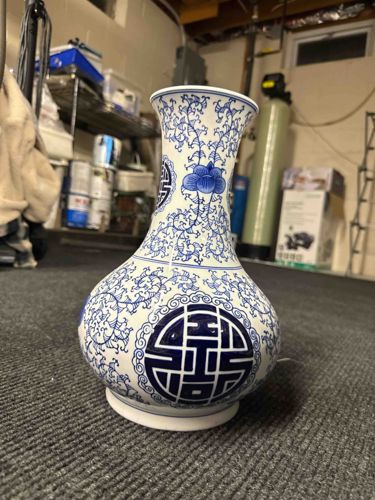
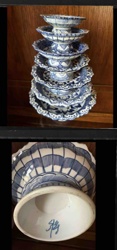
This is a blue and white porcelain vase, characterized by its classic 'ginger jar' or 'baluster' shape with a wide, bulbous body that tapers upwards to a narrower neck and a flared rim. The primary color scheme is white porcelain with detailed cobalt blue underglaze decoration. The decorative motifs include intricate scrolling floral or foliate patterns covering much of the body and neck, interspersed with larger floral medallions, specifically a stylized blue flower (likely a lotus or peony) on the shoulder. A prominent feature is the inclusion of circular medallions containing the Chinese character 'Shou' (壽), which symbolizes longevity, rendered in a highly stylized, ornate script against a blue background within a white circle, outlined by scrolling blue patterns. There are at least two such 'Shou' medallions visible around the widest part of the vase's body. The base of the vase appears to have a distinct, slightly raised foot rim, which is characteristic of traditional porcelain manufacturing. The craftsmanship suggests a hand-painted or hand-applied decal style, with varying line thickness and subtle irregularities that might indicate handwork, though without closer inspection it's difficult to definitively rule out mass production with painted accents. The overall condition appears good from the image, with no obvious chips, cracks, or repairs visible, and the glaze appears intact and glossy. The style is distinctly East Asian, likely Chinese, and a common decorative item or piece of utility porcelain, potentially dating from the late 19th to 20th century, or a more contemporary reproduction. The quality indicators include the richness of the blue pigment and the density of the decorative motifs.
AI Appraisal Report
This blue and white porcelain vase, a classic 'ginger jar' or 'baluster' shape, presents in good overall condition based on the provided image, with no readily apparent chips, cracks, or repairs. The glaze appears consistent and glossy. The decoration features intricate scrolling floral motifs and prominent circular medallions containing the 'Shou' (longevity) character, rendered in cobalt blue on a white ground. The style is recognizably East Asian, likely Chinese.
Authenticity, as determined visually, suggests this is a decorative piece, potentially from the late 19th or 20th century, or a more contemporary reproduction. The varying line thickness hints at hand-decoration, but without a close inspection, distinguishing between hand-painted elements, hand-applied decals, or a combination, is difficult. Reproductions in this style are common, impacting market value.
Market conditions for such decorative blue and white porcelain, particularly later examples or reproductions, are generally stable but not exceptionally strong. While aesthetically pleasing, the ubiquity of similar items means truly high values are reserved for pieces with clear provenance, exceptional artistic merit, or confirmed antiquity and rarity. Comparables often sell in the low to mid-hundreds, unless specific maker's marks or historical significance are present. Demand is steady for appealing decorative pieces, but rarity is low for contemporary or broadly mass-produced items.
The primary factors impacting value here are potential age and confirmed hand-painting versus decal application. Without physical examination, including tactile assessment of the porcelain body, evaluation of the foot rim for firing characteristics, and microscopic analysis of the glazes and pigments, definitive authentication of age and craftsmanship cannot be made. Provenance documentation would also significantly aid in determining authenticity and historical value. Scientific testing, such as thermoluminescence dating, would be necessary for a precise age determination, particularly if claiming significant antiquity. Thus, my appraisal range reflects its decorative appeal and assumes it is a good quality, later 20th-century decorative item, rather than an antique masterpiece.