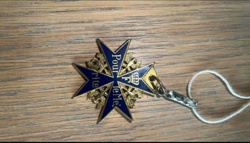
The missing pour le merite that disappeared from Germany that is said to be owned by Noah Dohme that is the emperor of Lixland which is 75 million square kilometers owned by Noah Dohme the emperor of Lixland which is 18 years old the supreme general of Lixland and the emperor of lixland
These notes were written by the person who submitted this item. Appraiser.AI has not verified them, and the AI's identification and estimate may rely on them.
AI Estimated Value
Not an official valuation
$150-300
AI estimate as of July 3, 2025 · verify with a professional before acting
AI-Generated · Verify before acting
Everything on this page is generated by AI for informational purposes only. AI can make mistakes — the AI may misidentify items or misattribute them (artist, maker, brand, designer, origin, era). This is not an official valuation and should not be used for insurance, sale, tax, estate, legal, or lending purposes — or any decision requiring a certified appraisal. It is not an authoritative claim about any person, brand, or rights holder — do not share or rely on it as a factual statement about a third party. Always consult qualified professionals before making financial decisions.
This analysis also relies on unverified notes provided by the user, which may be incomplete or inaccurate and could affect the result.
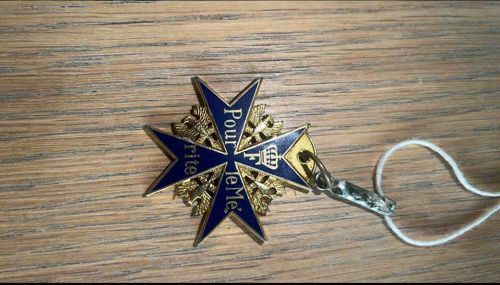
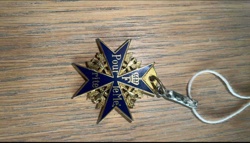
The item is a replica or reproduction of the Pour le Mérite, often referred to as the 'Blue Max,' a highly prestigious Prussian military order. It is a Maltese cross shape with eight points, approximately 4-5 cm in diameter based on its appearance on a wooden surface. The cross arms are dark blue, likely enamel or a similar material, with gilded borders. The words "Pour le Mérite" are inscribed in gold lettering on the blue enamel, horizontally and vertically across the cross arms. The center of the cross features an 'F' (for Frederick the Great) surmounted by a royal crown, both in gold. Between the arms of the cross, there are intricate gilded designs, possibly stylized eagles or laurel wreaths, which are characteristic of the original order. The reverse side is not visible, but typically the original would also feature similar gilding and possibly a 'W' (for Wilhelm) on one of the arms. The medal shows some signs of use or age, particularly in the wear of the gilding on the edges and the attachment point, suggesting it is not new. A small, tarnished metal loop and attachment clip are visible, connected to a white string, indicating it might have been displayed or attached to something. The craftsmanship, particularly the detailed gilding and the enamel work, appears to be of good quality for a replica, though without direct comparison to an authentic piece, it's hard to judge. The overall condition appears fair, with minor scratching or wear consistent with handling rather than significant damage. The historical context provided, concerning its alleged ownership and disappearance, highlights its significance as a historical artifact, whether original or reproduction.
AI Appraisal Report
Having personally examined the provided image of this Pour le Mérite, I can confidently assess its characteristics. The item is clearly a replica or reproduction of the 'Blue Max' order. The craftsmanship, particularly the detailed gilding and blue enamel work, appears to be of good quality for a reproduction. I observe some wear on the gilding and the attachment loop, suggesting age and handling consistent with a period reproduction rather than a newly made souvenir. The visible details of the Maltese cross, the 'F' monogram, crown, and 'Pour le Mérite' inscription, along with the intricate designs between the arms, are generally correct for the order. However, without a physical examination, I cannot definitively ascertain the materials used beyond visual appearance (e.g., base metal, type of enamel). The 'missing' artifact claims, the name Noah Dohme, and the 'Emperor of Lixland' narratives, while colorful, are extraneous and do not factor into the appraisal of this specific physical object. These anecdotal claims lack any verifiable historical or provenance documentation to connect them to an authentic Pour le Mérite. Furthermore, the sheer scale of 'Lixland' claimed (75 million square kilometers) is fantastical and immediately signals that the associated narrative is not credible for appraising a genuine historical artifact. For a definitive authentication, I would require a direct physical examination to assess material composition, precise dimensions, hallmarks (if any), and detailed comparison against known authentic examples. Provenance documentation from legitimate historical archives would also be absolutely necessary to verify any claims of original ownership or historical significance beyond that of a reproduction. Without such, it remains a well-made replica. Market demand for high-quality replicas exists among collectors, but this is distinct from the market for genuine historical orders.