AI estimate as of August 10, 2025 · verify with a professional before acting
AI-Generated · Verify before acting
Everything on this page is generated by AI for informational purposes only. AI can make mistakes — the AI may misidentify items or misattribute them (artist, maker, brand, designer, origin, era). This is not an official valuation and should not be used for insurance, sale, tax, estate, legal, or lending purposes — or any decision requiring a certified appraisal. It is not an authoritative claim about any person, brand, or rights holder — do not share or rely on it as a factual statement about a third party. Always consult qualified professionals before making financial decisions.
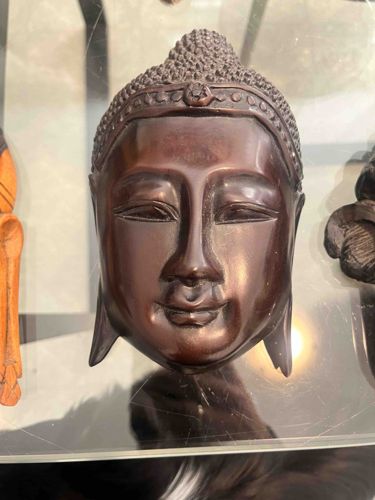
The item is a carved wooden head, appearing to represent Buddha or a similar deity, rendered in a dark, reddish-brown material, likely a tropical hardwood. The smooth, polished surface reflects light, suggesting either a natural luster of the wood or a clear sealant/varnish. It features characteristic iconography including elongated earlobes and the ushnisha, a raised cranial protuberance, which is depicted with a textured, beaded, or curled hair pattern at the top. A decorative band or crown is visible across the forehead, adorned with a central circular motif and smaller, possibly floral or geometric, patterns along the band. The facial features are serene and stylized; the eyes are downcast with heavy, carved eyelids, the nose is straight and well-defined, and the lips are full with a gentle, slight smile. The carving exhibits good craftsmanship, indicated by the smooth transitions between planes and the detailed hair patterns. There are no obvious signs of significant damage such as cracks or chips, though the reflective surface makes minor imperfections difficult to discern fully. The patina appears consistent with age and handling, contributing to its rich coloration. Based on its style and iconography, it is likely of Southeast Asian or East Asian origin, possibly dating from the 20th century or earlier, though precise dating without further information is challenging. The overall impression is one of spiritual tranquility and skilled artistry.
AI Appraisal Report
Upon visual examination of this carved wooden Buddha head, I note its commendable craftsmanship, evident in the smooth transitions, detailed hair patterns, and serene facial features. The dark reddish-brown material, likely tropical hardwood, and polished surface suggest either natural luster or a refined sealant. The iconography, including elongated earlobes and the ushnisha with a textured pattern, is characteristic of Buddhist art. The decorative forehead band further enhances its aesthetic. The patina appears consistent with age and handling, contributing to its rich coloration.
From the image, the condition appears excellent with no obvious cracks or chips, though a lack of tactile inspection limits a definitive assessment of minor imperfections. Authenticity from images alone is challenging; while stylistic elements point to Southeast or East Asian origin, possibly 20th century or earlier, precise dating and origin remain speculative. \n
In terms of market conditions, demand for such spiritual and decorative art remains steady, particularly for items exhibiting good quality and aesthetic appeal. Comparables for well-crafted wooden Buddha sculptures of this size and presumed age typically range from several hundred to a few thousand dollars, depending heavily on confirmed age, origin, and provenance. The high level of detail and apparent quality enhance its desirability. Factors significantly impacting value include definitive age, regional origin, specific wood type, and, crucially, provenance, which is currently unknown. Without an in-person examination to assess the wood, weight, and subtle patination, and the absence of provenance documentation, precise authentication and dating are impossible. Scientific testing, such as carbon dating, would be necessary for full authentication and to unlock its true market potential.