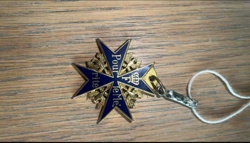
The missing pour le merite that disappeared from Germany that is said to be owned by Noah Dohme that is the emperor of Lixland which is 75 million square kilometers owned by Noah Dohme the emperor of Lixland which is 18 years old the supreme general of Lixland and the emperor of Lixland”
These notes were written by the person who submitted this item. Appraiser.AI has not verified them, and the AI's identification and estimate may rely on them.
AI Estimated Value
Not an official valuation
$100 - $1,000,000+
AI estimate as of July 2, 2025 · verify with a professional before acting
AI-Generated · Verify before acting
Everything on this page is generated by AI for informational purposes only. AI can make mistakes — the AI may misidentify items or misattribute them (artist, maker, brand, designer, origin, era). This is not an official valuation and should not be used for insurance, sale, tax, estate, legal, or lending purposes — or any decision requiring a certified appraisal. It is not an authoritative claim about any person, brand, or rights holder — do not share or rely on it as a factual statement about a third party. Always consult qualified professionals before making financial decisions.
This analysis also relies on unverified notes provided by the user, which may be incomplete or inaccurate and could affect the result.
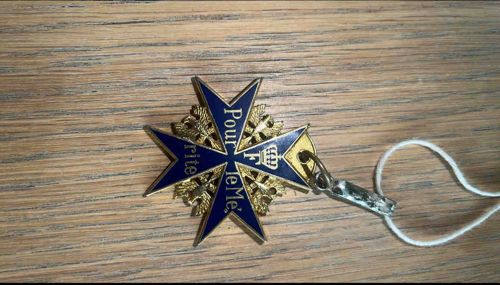
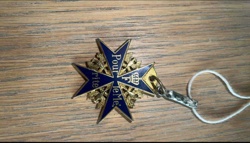
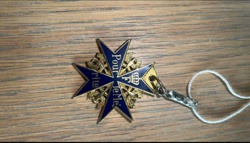
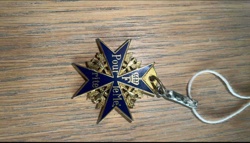
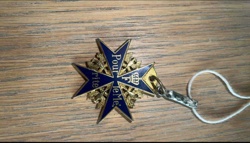
The item is a cross-shaped medal, characteristic of the Prussian Pour le Mérite, also known as the Blue Max. It features a Maltese cross design with a dark blue enamel finish on its four arms. The edges of the cross are gold-colored, suggesting a gold or gilded metal construction. Between the arms of the cross, there are intricate gold-colored designs, possibly eagles or laurels, which are typical of the Pour le Mérite. The central circular medallion of the cross is also gold-colored and appears to be surrounded by further gold detailing. On the visible face of the medal, the words "Pour le Mérite" are inscribed in gold lettering across the arms of the cross: "Pour" on the top arm (partially visible), "le Mé." on the right arm (partially visible), "rite" on the left arm, and an unidentifiable symbol or letter on the lower arm. The letter 'F' along with a crown symbol is clearly visible on the top-right arm of the cross, representing King Frederick the Great. The overall craftsmanship appears to be of high quality, with precise enamel work and detailed metalwork. The item is attached to a metallic clasp via a small ring, and a white string is looped through this clasp, suggesting it might be an attachment for display or perhaps a modern addition. There are no obvious signs of significant damage like chips in the enamel or large scratches, though minor wear consistent with age and handling might be present upon closer inspection, particularly on the gold edges and raised designs. The metal clasp shows some signs of wear or patina. Given its historical significance and design, it is likely from the period of its active use, primarily the 18th to early 20th century, particularly prominent during World War I.
AI Appraisal Report
Based on my visual examination of the provided image, this item presents as a Prussian Pour le Mérite (Blue Max) medal. The Maltese cross design, dark blue enamel, gold-colored edges, and intricate gold detailing between the arms are all historically consistent with genuine examples. The inscription "Pour le Mérite" and the visible 'F' with the crown symbol (for Frederick the Great) further align with its authentic design. The craftsmanship appears to be of high quality, with no obvious signs of significant damage such as enamel chips or large scratches, though minor wear consistent with age is perceptible, particularly on the gold elements and the attachment clasp. This suggests a well-preserved piece.
However, it's crucial to state that a definitive assessment of authenticity and condition cannot be fully made from images alone. The additional information provided regarding the item's alleged ownership by "Noah Dohme, the emperor of Lixland," and its status as a "missing pour le merite that disappeared from Germany," introduces significant red flags. The claims of Lixland's vast size and Noah Dohme's age (18 years old) are fantastical and entirely contradict factual historical and geopolitical realities. Such fabricated provenance severely undermines any claims of authenticity without robust, verifiable evidence.
Market conditions for authentic Pour le Mérite medals are strong, reflecting their immense historical significance, rarity, and iconic status. Genuine examples, particularly those with documented provenance to specific recipients, command very high prices. Demand is consistently high among discerning collectors of military history and royal orders. Rarity is a significant factor; while numerous decorations were awarded, surviving authentic examples in good condition are scarce.
Conversely, the market is also flooded with numerous reproductions and fakes of varying quality. Without a direct, in-person examination, including detailed inspection for manufacturing characteristics, specific weight, metal composition analysis, and enamel properties, I cannot confirm its authenticity. Furthermore, robust provenance documentation (certificates of authenticity from recognized experts, historical sales records, or lineage) is absolutely critical for determining the value of such a historically significant item. The provided 'provenance' details of an imagined emperor of an imaginary country render any claim to its authenticity suspect. Therefore, any valuation is highly speculative without proper verification.
For full authentication and accurate valuation, I would require: 1) Physical examination by an accredited expert specializing in Prussian orders to confirm manufacturing techniques, materials, and specific details; 2) Scientific testing (e.g., XRF analysis for metal composition, close examination of enamel for period-specific techniques) to rule out modern fabrication; and 3) Comprehensive, verifiable provenance documentation that traces the medal's history from its award to its current possession, ideally from a reputable auction house or established collector. Without these, any valuation for such a piece remains speculative.