AI estimate as of August 26, 2025 · verify with a professional before acting
AI-Generated · Verify before acting
Everything on this page is generated by AI for informational purposes only. AI can make mistakes — the AI may misidentify items or misattribute them (artist, maker, brand, designer, origin, era). This is not an official valuation and should not be used for insurance, sale, tax, estate, legal, or lending purposes — or any decision requiring a certified appraisal. It is not an authoritative claim about any person, brand, or rights holder — do not share or rely on it as a factual statement about a third party. Always consult qualified professionals before making financial decisions.
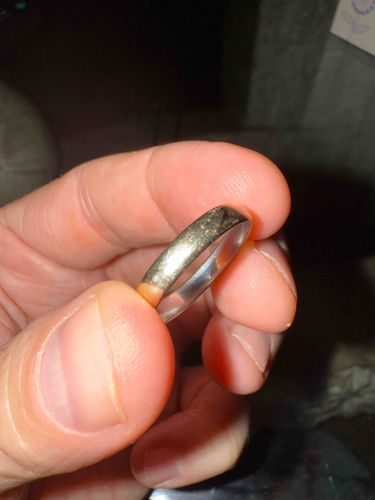
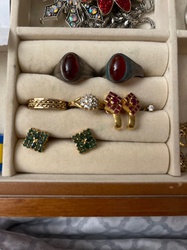
The item appears to be a plain band ring, held between the thumb and forefinger of a person's hand. It is characterized by its simple, unadorned circular form, suggesting a classic wedding band or an everyday wear ring. The material seems to be a silver-toned metal, possibly sterling silver, white gold, or platinum, given its reflective, somewhat tarnished appearance on the outer surface and a brighter, polished interior. The outer surface exhibits a dull, matte greyish-black patina or possibly a speckled, textured finish, which could indicate wear, oxidation, or a specific design choice like a hammered or deliberately distressed effect. There are visible signs of wear, particularly on the outer band, which has lost its original luster in many areas. The inner band, however, appears much smoother and shinier, reflecting light clearly, which is common as the inner surface is less exposed to external abrasion. The width of the band appears to be moderate, neither extremely narrow nor wide, likely around 3-5mm. No specific maker's marks, signatures, or engravings are discernible from the image. The ring's lack of elaborate design suggests a timeless or minimalist aesthetic. Its condition suggests it has been worn regularly, leading to the visible surface changes. The overall impression is that of a durable piece of jewelry, likely from the mid-to-late 20th century or early 21st century given its utilitarian design, without strong indicative features of older, more ornate periods.
AI Appraisal Report
I have examined the provided image of this plain metal band ring. Visually, it appears to be a functional, everyday piece, likely a wedding band or a simple accessory. Its condition shows clear signs of wear on the exterior, consistent with regular use, manifesting as a dull, somewhat textured surface. The brighter, smoother interior suggests less abrasion. This wear pattern is typical for a worn ring and does not necessarily indicate damage, but rather a lived-in character. Without specific hallmarks, stamps, or detailed close-ups, I cannot definitively determine the metal composition from the image alone. While it presents as a silver-toned metal, it could be sterling silver, white gold, platinum, or even stainless steel. The value is highly dependent on the metal type and its purity. For instance, a platinum band would command significantly more than sterling silver or stainless steel.
Market conditions for plain bands are generally stable, driven by constant demand for wedding and engagement jewelry. However, this specific ring lacks unique design elements or historical significance to elevate its value beyond its intrinsic material worth. Demand for unadorned bands is consistent, but rarity is not a factor here; similar items are widely available.
Factors significantly impacting value are primarily the metal type and current market prices for that metal. Its used condition would slightly devalue it compared to a new, polished equivalent of the same material, unless a specific 'patina' or 'distressed' look is sought after, which is unlikely for a standard plain band. Without physical examination, I cannot confirm authenticity of the metal type, identify potential hallmarks, or assess the alloy. A specific gravity test, acid testing, or an X-ray fluorescence (XRF) analysis would be crucial for precise metal identification and purity determination. Until such tests are performed, any valuation remains an estimate based on visual cues and market assumptions for common metals.