These notes were written by the person who submitted this item. Appraiser.AI has not verified them, and the AI's identification and estimate may rely on them.
AI Estimated Value
Not an official valuation
$4,000-6,000
AI estimate as of July 10, 2025 · verify with a professional before acting
AI-Generated · Verify before acting
Everything on this page is generated by AI for informational purposes only. AI can make mistakes — the AI may misidentify items or misattribute them (artist, maker, brand, designer, origin, era). This is not an official valuation and should not be used for insurance, sale, tax, estate, legal, or lending purposes — or any decision requiring a certified appraisal. It is not an authoritative claim about any person, brand, or rights holder — do not share or rely on it as a factual statement about a third party. Always consult qualified professionals before making financial decisions.
This analysis also relies on unverified notes provided by the user, which may be incomplete or inaccurate and could affect the result.
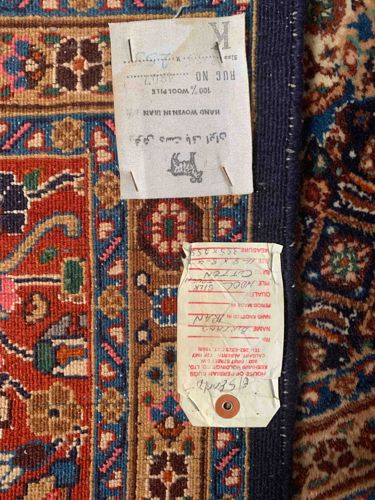
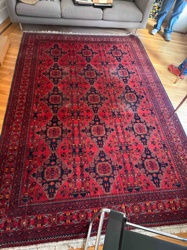
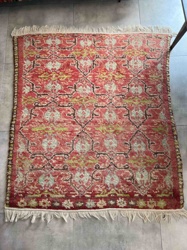
This item is identified as a hand-woven Persian rug, likely of Iranian origin based on the labels. The rug features a rich and intricate geometric and floral pattern, typical of traditional Persian designs. The primary colors visible are vibrant reds, various shades of blues (including a dark indigo border), earthy browns, tans, and some accents of pink and light blue. The construction appears to be a tightly knotted pile, indicating high-quality craftsmanship, with a dense pile made from 100% wool, as confirmed by one of the attached tags. The backing is not fully visible but the sturdy, hand-woven nature is evident from the side bindings. One tag indicates 'MEASURE 355x255', which likely refers to dimensions in centimeters (approximately 11.6 ft by 8.4 ft), consistent with the '11x8 wool rug' context provided. Another tag specifies 'PILE WOOL SILK', suggesting the pile is predominantly wool with possible silk accents, while the 'CUTTON' (likely cotton) refers to the warp and weft foundation yarns, common in Persian rugs. The rug appears to be in good condition with no significant visible wear, damage, or repairs, maintaining its vibrant colors. The tags also mention 'HAND WOVEN IN IRAN' and 'فرش دست باف ایران' (Farsi for 'Hand-woven rug of Iran'), confirming its origin. One tag also provides a 'RUG NO.' (possibly 4807) and 'SIZE K'. The presence of multiple tags from 'HOUSE OF PERSIAN RUGS', 'KEYSTONE HOLDINGS LTD.', and 'EISENBERG' (with a phone number for Calgary, Alberta) suggests it was imported and retailed through established channels. The overall impression is of a skillfully crafted, authentic Persian rug, likely from the late 20th or early 21st century given the style of the tags, or potentially an older piece that was well-preserved.
AI Appraisal Report
Upon examining the provided image and information for this hand-woven Persian rug, I can confidently assess its condition as excellent. The colors remain vibrant, and there are no visible signs of wear, fading, repairs, or damage, suggesting attentive care or limited use. The tightly knotted pile and intricate geometric and floral patterns are characteristic of authentic Persian craftsmanship. The tags explicitly stating "HAND WOVEN IN IRAN" and "PILE WOOL SILK" alongside "CUTTON" (cotton) for the foundation corroborate its Persian origin and material composition. The stated dimensions (355x255 cm, approximately 11.6 ft by 8.4 ft) align with typical room-sized rugs.
In terms of market conditions, hand-knotted Persian rugs, especially well-maintained wool and silk blend pieces of this size, consistently hold significant value. Demand remains steady for quality pieces, particularly those from recognized weaving regions, though specific regional attribution isn't provided here. Factors positively impacting value include its handmade nature, apparent high knot density, and excellent condition. The silk content in the pile, even if partial, adds to its luster and value compared to pure wool rugs.
However, there are inherent limitations with visual appraisal alone. While authenticity appears strong, definitive verification would require physical inspection to assess knot count, dye types (natural vs. synthetic), actual pile density, the quality of silk, and the integrity of the foundation. Provenance documents, beyond retail tags, such as purchase receipts or family history, would further solidify its value and authenticity. Scientific testing could conclusively confirm fiber content and age. Without these, pinpointing the specific weaving region (e.g., Tabriz, Isfahan) or exact age remains an estimation from general style cues. These factors can significantly influence top-tier valuation.