AI estimate as of July 25, 2025 · verify with a professional before acting
AI-Generated · Verify before acting
Everything on this page is generated by AI for informational purposes only. AI can make mistakes — the AI may misidentify items or misattribute them (artist, maker, brand, designer, origin, era). This is not an official valuation and should not be used for insurance, sale, tax, estate, legal, or lending purposes — or any decision requiring a certified appraisal. It is not an authoritative claim about any person, brand, or rights holder — do not share or rely on it as a factual statement about a third party. Always consult qualified professionals before making financial decisions.
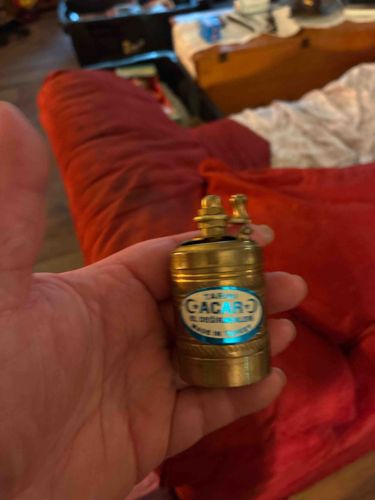
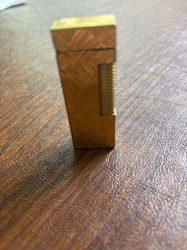
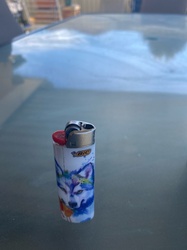
The item appears to be a small, cylindrical brass or brass-toned metal lighter, commonly referred to as a trench lighter or a 'trench oil lighter'. Its compact size suggests it is designed to be easily carried. The main body of the lighter is constructed from a polished or brushed brass, which shows some minor surface scratches and handling wear consistent with its age and intended use, but no significant dents or damage are visible. The top of the lighter features two distinct elements: a knurled or grooved top on the left, likely the wick cover/flint wheel mechanism, and a smaller, rounded part on the right, which could be the fuel cap or an ancillary component. There's a label on the side of the brass body, which is oval-shaped with a light blue background and a darker blue border. The text on the label, though slightly blurry, clearly reads "TARIN" at the top, "GACARO" in large, prominent letters, and below it, smaller text "EL DEGISIM KLIK" and "MADE IN TURKEY". The presence of 'TARIN' and 'GACARO' suggests a brand name or model. The 'MADE IN TURKEY' inscription indicates its country of origin. The overall condition suggests that while it has been used, it has been reasonably well-maintained. The brass exhibits a characteristic warm golden hue, and there's a slight patina forming in areas, which is expected for brass over time. The craftsmanship appears to be functional and utilitarian, typical of lighters designed for durability rather than intricate decoration. Based on the style and the 'Made in Turkey' marking, it likely dates from the mid to late 20th century, possibly 1950s-1970s, a period when such simple, robust lighters were common.
AI Appraisal Report
Upon examining the provided image of the Gacaro Trench Oil Lighter, I assess its condition as good, showing typical signs of use consistent with its age. The minor surface scratches and slight patina on the brass are expected and contribute to its character rather than detracting significantly from its value. There are no visible major dents or damages. Authenticity, based solely on the image, appears strong due to the clear "GACARO" and "MADE IN TURKEY" markings. This type of utilitarian trench lighter, while functional, generally occupies a niche market. Comparables for standard trench lighters from the mid to late 20th century typically fetch modest prices. Demand for this specific Gacaro brand is low, as it's not a widely recognized or highly collectible name like Zippo or Ronson. Its rarity is not significant; many similar lighters were produced. Factors impacting value are primarily its functionality and the appeal of vintage brass items. However, the lack of historical significance or unique design limits its upper value potential. Limitations in authenticity verification from images alone are crucial; I cannot assess internal mechanisms, material composition beyond visual brass, or confirm if components are original. A physical examination would allow me to test its functionality, inspect the flint mechanism and wick, and confirm the absence of repairs or modifications. Provenance documentation, such as original packaging or purchase records, would further solidify its history. Scientific testing is not typically required for items of this nature unless there were questions about the metal composition.