AI estimate as of July 14, 2025 · verify with a professional before acting
AI-Generated · Verify before acting
Everything on this page is generated by AI for informational purposes only. AI can make mistakes — the AI may misidentify items or misattribute them (artist, maker, brand, designer, origin, era). This is not an official valuation and should not be used for insurance, sale, tax, estate, legal, or lending purposes — or any decision requiring a certified appraisal. It is not an authoritative claim about any person, brand, or rights holder — do not share or rely on it as a factual statement about a third party. Always consult qualified professionals before making financial decisions.
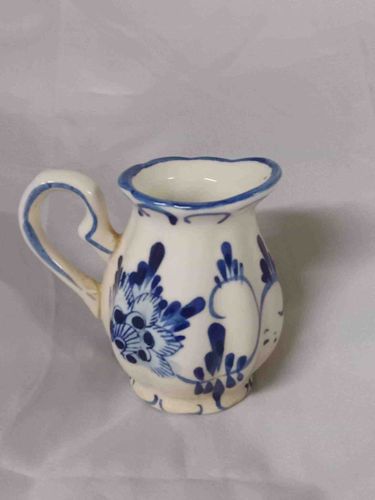
This item is a small, decorative ceramic creamer or milk pitcher, characterized by its traditional blue and white Delftware-style decoration. It measures approximately 4-5 inches in height and 3-4 inches in width at its widest point, with a flared rim and a single, loop handle. The primary material is a white-glazed earthenware or porcelain. The body of the pitcher is bulbous, tapering slightly towards the base which rests on a small, round foot. The rim is unevenly scalloped with a blue edge, suggesting a handcrafted element, or possibly wear. The dominant decoration consists of hand-painted blue floral and foliate motifs that wrap around the body of the pitcher. These designs appear to be stylized representations of flowers and swirling leaves, typical of Dutch or European chinoiserie influences. The blue pigment varies in intensity, showing lighter and darker shades, indicative of hand-application and possibly giving a watercolor-like effect in some areas. The handle also features a blue stripe along its curve. The overall condition appears good with no obvious chips, cracks, or repairs visible in the provided image. There may be minor manufacturing imperfections or signs of age-related crazing, though these are not clearly discernible from the picture. The glaze appears consistent, lending a smooth, glossy finish. The craftsmanship suggests it is either an antique piece or a modern reproduction in a traditional style. Without specific maker's marks, dating is approximate, but the style is characteristic of pieces produced from the 18th to early 20th centuries, or later decorative reproductions.
AI Appraisal Report
I have examined the image of this Delftware-style ceramic creamer. Visually, the piece appears to be in very good condition with no apparent chips, cracks, or repairs, and the glaze seems intact and glossy. The hand-painted blue floral and foliate motifs, characteristic of Delftware and chinoiserie influences, show varying pigment intensity, common in hand-decorated items. The scalloped rim, though appearing slightly uneven, could simply be a design element or a sign of handcrafted origin rather than wear.
Authenticity is a key factor here. While the style is very reminiscent of 18th to early 20th-century Delftware, without physical inspection, identifying specific maker's marks or the texture of the earthenware cannot be done definitively. Many reproductions of this style exist. Currently, the market for Delftware is stable, with demand for genuine antique pieces remaining consistent, especially those with documented provenance or rare marks. However, later reproductions, even well-made ones, fetch significantly lower prices.
Factors impacting value include age, authenticity, condition, and rarity of the specific motif or maker. Given the visual information alone, I cannot definitively confirm its age or authenticity as an antique. My appraisal is based on it being a well-preserved Delftware-style ceramic creamer, potentially a vintage reproduction or a less valuable antique. To confirm authenticity as an antique, I would need to physically examine the piece for maker's marks, paste quality, signs of age like crazing, and potentially conduct scientific tests on the glaze and clay. Provenance documentation would also be crucial. For these reasons, my appraisal value accounts for the possibility of it being a charming decorative item rather than a highly collectible antique.