AI estimate as of October 28, 2025 · verify with a professional before acting
AI-Generated · Verify before acting
Everything on this page is generated by AI for informational purposes only. AI can make mistakes — the AI may misidentify items or misattribute them (artist, maker, brand, designer, origin, era). This is not an official valuation and should not be used for insurance, sale, tax, estate, legal, or lending purposes — or any decision requiring a certified appraisal. It is not an authoritative claim about any person, brand, or rights holder — do not share or rely on it as a factual statement about a third party. Always consult qualified professionals before making financial decisions.
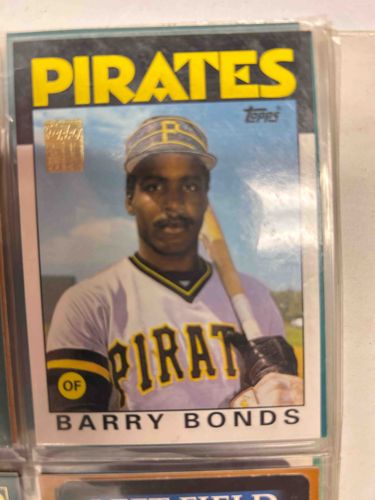
This item is a 1987 Topps baseball card featuring Barry Bonds, then a player for the Pittsburgh Pirates. The card showcases a portrait-style photograph of Bonds wearing a light-colored (likely white or cream) Pirates jersey with yellow and black trim, holding a baseball bat on his shoulder. He is also wearing a Pirates baseball cap with the iconic 'P' logo. The background appears to be an outdoor baseball field setting with a blue sky. The card's design includes a prominent black banner at the top with 'PIRATES' in bold yellow lettering. The Topps logo is visible in the upper right corner of the image portion. A gold foil stamp, possibly indicating a special issue or parallel, is located in the upper left corner of the image. Below the player's photograph, there is a white border with the text 'OF' in a small yellow circle followed by 'BARRY BONDS' in black capital letters. The card exhibits a standard size for baseball cards of that era, typically 2.5 by 3.5 inches, and is printed on cardstock. Visually, the card appears to be in good condition, protected within a clear plastic sleeve or binder page, showing no obvious creasing, tears, or significant discoloration. The colors remain vibrant. This card represents an early career issue for Barry Bonds, a significant figure in baseball history, adding to its potential collectible value. The craftsmanship is typical of mass-produced sports cards of the late 1980s, focusing on clear player imagery and consistent branding.
AI Appraisal Report
Based on my visual examination of the provided image, this 1987 Topps Barry Bonds card appears to be in at least good, if not excellent, condition. The colors are vibrant, and there are no apparent creases, tears, or significant surface imperfections visible, suggesting it has been well-preserved, likely in a protective sleeve or holder. The gold foil stamp in the upper left corner, while noted, is a common feature on many Topps cards from this era and doesn't inherently indicate a rare parallel unless it's a specific, recognized variation (which is difficult to ascertain from the image alone without a list of parallels for this specific set).
Authenticity, based on the visual, seems high given it's a mass-produced Topps card from the era, and there are no immediate red flags indicating counterfeiting, which is less common for cards of this specific value range. However, definitive authenticity verification would require in-hand examination to assess print quality, cardstock, and corner cuts, as well as checking against known authentic examples. Provenance documentation, while beneficial for high-value items, is less critical for a card of this type.
Regarding market conditions, 1987 Topps was a heavily produced set, leading to ample supply. While Barry Bonds is a significant player, this card is not his rookie card (which is the 1986 Topps Traded and 1986 Fleer Update). As a second-year card, demand is moderate. Comparable sales for 1987 Topps Barry Bonds cards in raw, good-to-excellent condition typically range from $5 to $20. Graded examples in Gem Mint (PSA 10) condition can fetch higher prices, sometimes exceeding $100, but without professional grading, this cannot be assumed.
The primary factors impacting current value are its condition and the fact that it is not his rookie card. The perceived good condition seen in the image is a positive factor. Without physical inspection and potential professional grading for centering, sharp corners, and surface, the exact condition cannot be definitively confirmed, which limits a precise higher valuation. Scientific testing is generally not required for sports cards of this value.