These notes were written by the person who submitted this item. Appraiser.AI has not verified them, and the AI's identification and estimate may rely on them.
AI Estimated Value
Not an official valuation
$100-175
AI estimate as of August 9, 2025 · verify with a professional before acting
AI-Generated · Verify before acting
Everything on this page is generated by AI for informational purposes only. AI can make mistakes — the AI may misidentify items or misattribute them (artist, maker, brand, designer, origin, era). This is not an official valuation and should not be used for insurance, sale, tax, estate, legal, or lending purposes — or any decision requiring a certified appraisal. It is not an authoritative claim about any person, brand, or rights holder — do not share or rely on it as a factual statement about a third party. Always consult qualified professionals before making financial decisions.
This analysis also relies on unverified notes provided by the user, which may be incomplete or inaccurate and could affect the result.
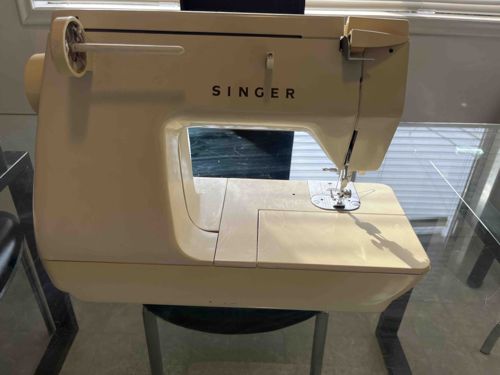
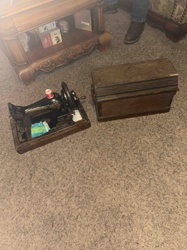
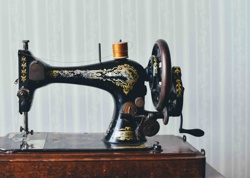
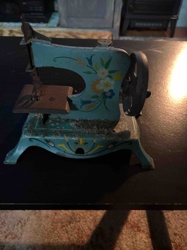
The item is identified as a Singer Touch-Tronic 2010 Memory Machine, a vintage electronic sewing machine from the late 1970s or early 1980s. Physically, it presents as a relatively compact, desktop model with an outer casing predominantly in a light, creamy beige or off-white color. The construction appears to be a durable plastic or composite material, typical for domestic sewing machines of its era, with metal components for the internal mechanisms, needle, presser foot, and bobbin winder. The machine has a smooth, rounded aesthetic with clean lines. Key features include the prominent 'SINGER' branding in black lettering on the front side of the upper arm. The bobbin winder spindle is visible on the top left, along with a tension disc. The needle and presser foot assembly are clearly visible on the sewing bed, indicating a straight stitch and potentially zig-zag capability, though specific stitch patterns cannot be discerned from the image. The removable accessory tray, which forms part of the flat sewing bed, is also visible. The overall condition appears good for its age, with no significant cracks, chips, or deep scratches immediately apparent on the casing. There might be minor scuffs or discoloration consistent with general use and age, often referred to as patina. The metallic parts show some oxidation wear, as expected. Its 'Touch-Tronic' and 'Memory Machine' designations indicate advanced electronic features for its time, likely including programmable stitches and electronic controls rather than purely mechanical dials. This machine represents a transition period in sewing technology, offering early electronic automation to home sewers. The craftsmanship appears to be of standard Singer quality for home-use machines, built for durability and reliability.
AI Appraisal Report
Upon examining the provided image and information for this Singer Touch-Tronic 2010 Memory Machine, I assess its condition as good for its age. The casing appears largely intact with minor scuffs or discoloration, typical patina for a machine from the late 1970s/early 1980s. The 'SINGER' branding is clear, and key components like the bobbin winder, tension disc, needle, and presser foot assembly are visible. Small signs of oxidation on metallic parts are expected. This model represents an early foray into electronic sewing machines, signifying a technological transition, which adds a layer of interest.
In terms of market conditions, vintage electronic sewing machines like the Touch-Tronic 2010 generally appeal to a niche market of sewing enthusiasts, collectors of vintage electronics, or those seeking a durable, older machine for practical use. Comparables for this specific model are not abundant, but similar higher-end electronic machines from this era typically fetch between $75 and $200, depending heavily on working condition, accessories, and promotional effectiveness. Its 'Memory Machine' feature suggests advanced capabilities for its time, which slightly elevates its appeal over purely mechanical models.
Demand is moderate; while not rare, early electronic machines hold more interest than common mechanical ones. Factors significantly impacting value include confirmed working condition, the presence of original accessories (manual, foot pedal, bobbins, specialty feet), and whether it comes with its original hard case or carrying bag. Machines in non-working condition generally have negligible value unless for parts.
Regarding authenticity, the visible branding and model name appear consistent with known Singer products. However, my assessment is based solely on visual inspection of the provided image. For full authentication and accurate valuation, an in-person physical examination is crucial to confirm the machine's functional status, inspect internal mechanisms for wear or damage, verify all electronic functions, and catalog all included accessories. Provenance documentation (original purchase receipts, service history) would further enhance certainty but is rarely available for items of this age.