These notes were written by the person who submitted this item. Appraiser.AI has not verified them, and the AI's identification and estimate may rely on them.
AI Estimated Value
Not an official valuation
$25 - $40
AI estimate as of October 13, 2025 · verify with a professional before acting
AI-Generated · Verify before acting
Everything on this page is generated by AI for informational purposes only. AI can make mistakes — the AI may misidentify items or misattribute them (artist, maker, brand, designer, origin, era). This is not an official valuation and should not be used for insurance, sale, tax, estate, legal, or lending purposes — or any decision requiring a certified appraisal. It is not an authoritative claim about any person, brand, or rights holder — do not share or rely on it as a factual statement about a third party. Always consult qualified professionals before making financial decisions.
This analysis also relies on unverified notes provided by the user, which may be incomplete or inaccurate and could affect the result.
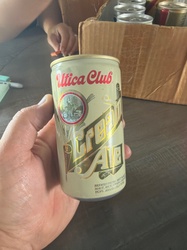
This item is a vintage, empty Highlander Premium Beer can, likely a steel flat-top variety with a seam down the side. The can features a primary color scheme of white and red. The upper and lower bands, as well as the 'Highlander' script logo, are set against a white background, while the central portion and ends are predominantly red with a diagonal plaid-like pattern in a darker red. The brand name 'Highlander' is prominently displayed in a stylized black script font outlined in white, with accompanying text 'PREMIUM BEER' in red block letters, also outlined in white. Below this, smaller print indicates 'BREWED BY MISSOULA BREWING CO.' (partially obscured but visible in context image). The top of the can is a flat, uncolored metal surface, indicating it was opened with a can opener, characteristic of older beer cans (a 'flat top'). The can exhibits significant signs of age and wear, including rust, particularly on the top surface and around the rims, as well as general staining and discoloration on the white and red painted areas. There are visible scuffs and scratches on the painted surfaces, suggesting outdoor storage or rough handling over time. The structural integrity appears to be mostly intact, though the surface rust indicates corrosion. The can likely dates from the mid-20th century, probably between the 1930s and 1960s, given the flat-top design which predates the pull-tab and pop-top innovations. The overall condition suggests it is a salvaged or collected piece rather than an item preserved for display. The 'Missoula Brewing Co.' information is a key identifying detail, linking it to a specific historical brewery. The craftsmanship is typical of mass-produced beverage containers of its era.
AI Appraisal Report
Based on my visual examination of the provided image, this Highlander Premium Beer can appears to be an authentic vintage steel flat-top. The design elements, including the 'Highlander' script, 'PREMIUM BEER' text, and 'BREWED BY MISSOULA BREWING CO.' indication, are consistent with known examples from the mid-20th century, likely dating between the 1930s and 1960s. The flat-top design specifically places it within this earlier period of beer can manufacturing. The visible side seam also supports this dating. My assessment of its condition is fair to poor. There is significant rust, particularly on the top and rims, and substantial paint loss, scuffs, and discoloration across the body. This level of wear suggests outdoor exposure or rough handling over many years, significantly impacting its aesthetic appeal to collectors. The structural integrity seems generally intact, but the corrosion is undeniable.
In terms of market conditions, vintage beer cans, especially flat-tops from regional breweries like Missoula Brewing Co., have a dedicated collector base. However, condition is paramount. Cans in near-mint or excellent condition fetch premium prices, often in the hundreds of dollars. This can's poor condition places it at the lower end of the value spectrum. Rarity for this specific Highlander can is moderate; while not exceedingly rare, it's not commonly found in excellent shape. Factors significantly impacting its value negatively are the extensive rust and paint degradation.
For full authentication, a physical examination would be crucial. I would need to inspect the weight, feel of the metal, and any internal corrosion. Provenance documentation, such as where and when it was acquired, could also add to its authenticity claims. Without physical inspection, I cannot definitively rule out modern reproductions or touch-ups, although the visible wear patterns seem consistent with genuine age. Given its current condition and market comparables for similar cans in poor shape, I estimate its appraisal value to be between $25 and $40. A can in excellent condition could command significantly more.