AI estimate as of August 9, 2025 · verify with a professional before acting
AI-Generated · Verify before acting
Everything on this page is generated by AI for informational purposes only. AI can make mistakes — the AI may misidentify items or misattribute them (artist, maker, brand, designer, origin, era). This is not an official valuation and should not be used for insurance, sale, tax, estate, legal, or lending purposes — or any decision requiring a certified appraisal. It is not an authoritative claim about any person, brand, or rights holder — do not share or rely on it as a factual statement about a third party. Always consult qualified professionals before making financial decisions.
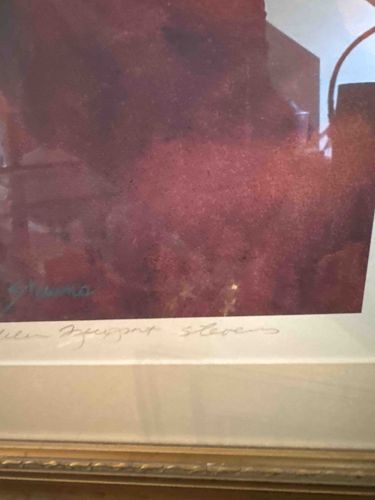
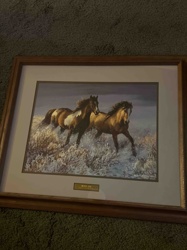
The item is a framed art print, likely a lithograph or giclée, featuring a dominant color palette of deep reds and maroons, suggesting an abstract or atmospheric scene. The surface of the print appears somewhat textured and slightly mottled due to potential dust accumulation or the nature of the print itself, evident in the subtle speckling visible across the darker red areas. There are visible reflections on the surface, indicating the presence of a protective glazing, most likely glass, which suggests the print is professionally framed. The visible area of the artwork is predominantly a rich, warm red with darker nuances. In the lower left corner of the print, there is a visible signature in what appears to be a light blue or teal color, although the full signature is not clearly decipherable from the image. Below the print, on what seems to be a mat board, there is a handwritten signature in graphite or light pencil, which reads "Helen Knuph Stevens." This second signature suggests the artist's personal endorsement of the print. The print is housed within a multi-layered framing system. There is a wide, light-colored mat board, possibly cream or off-white, providing a substantial border around the artwork. The outer frame is gold-toned, featuring an ornate, possibly carved or molded, pattern along its inner edge, indicating a decorative and somewhat classical or traditional aesthetic. The frame shows some signs of wear consistent with age, but no significant damage is apparent. The overall presentation suggests a piece from the late 20th or early 21st century, given its style of framing and the common practice of numbered or signed prints.
AI Appraisal Report
Upon visual examination of the provided image, I assess this framed art print, signed "Helen Knuph Stevens," to be in good condition. The print itself, likely a lithograph or giclée, displays a rich red and maroon abstract composition. There is minor visible surface mottling, which appears to be dust accumulation on the protective glazing rather than damage to the print itself. The presence of reflections indicates glazing, likely glass, which has protected the artwork well. The framing system, consisting of a wide light-colored mat and an ornate gold-toned frame, shows some age-consistent wear but no significant damage. The double signature—one in light blue/teal on the print itself (though not fully legible) and a clear graphite signature "Helen Knuph Stevens" on the mat—suggests authenticity and an artist's personal endorsement.
From the image alone, an absolute verification of authenticity is limited. While the presence of two signatures is positive, in-person examination would be crucial to confirm the media, the type of print, and the exact match of the on-print signature to known examples of Stevens's work. Provenance documentation, such as a certificate of authenticity, gallery receipts, or exhibition records, would significantly enhance the valuation. Scientific testing for ink composition or comparative analysis of printing techniques would provide definitive authentication.
Regarding market conditions, abstract prints from lesser-known but collected artists typically appeal to a niche market. "Helen Knuph Stevens" does not immediately register as a widely recognized name in public auction records, suggesting a more regional or private collector base. Therefore, demand is likely moderate. Rarity is difficult to assess without knowing the edition size (if it is a limited edition print).
Factors impacting value include the good condition, the professional framing, and the dual signatures. The primary limitation is the artist's current market visibility. Without a strong auction presence or established secondary market, the value is primarily decorative and collectible among those familiar with her work.
Considering these factors, and acknowledging the limitations of a remote appraisal, the value is primarily driven by its decorative appeal and collectible nature for an artist of this apparent tier.