AI estimate as of November 10, 2025 · verify with a professional before acting
AI-Generated · Verify before acting
Everything on this page is generated by AI for informational purposes only. AI can make mistakes — the AI may misidentify items or misattribute them (artist, maker, brand, designer, origin, era). This is not an official valuation and should not be used for insurance, sale, tax, estate, legal, or lending purposes — or any decision requiring a certified appraisal. It is not an authoritative claim about any person, brand, or rights holder — do not share or rely on it as a factual statement about a third party. Always consult qualified professionals before making financial decisions.
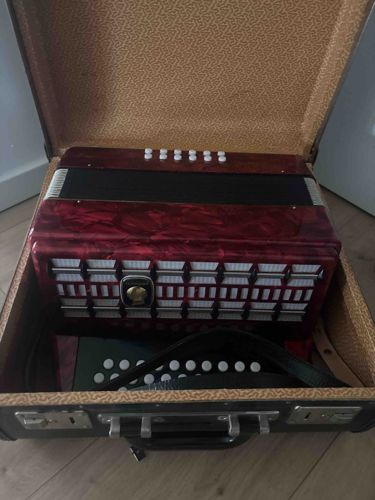
The item is a button accordion, housed within its open carrying case. The accordion itself features a striking dark red, marbled or pearlescent finish on its main body, suggesting a celluloid or similar plastic veneer over wood. The instrument appears rectangular in shape, typical of many accordions. On the upper surface, seven white button-like keys are visible, likely part of the treble side keyboard. The bass side, partially obscured, shows an array of white round buttons set against a dark green or black panel, consistent with a diatonic or chromatic button accordion configuration. The bellows are not fully visible but appear to be black. The grille on the treble side is predominantly white with horizontal and vertical bars forming a grid pattern, and in its center, there's a distinctive gold-colored emblem or badge, possibly indicating the manufacturer or model. The overall condition from the visible areas seems fair to good, with no obvious major damage, although minor scuffs or wear consistent with age and use might be present on closer inspection. The case itself is a practical, utilitarian piece, black on the exterior with metallic latches and a handle, lined with a light brown fabric featuring a repeating textured pattern. The style of the accordion, particularly the marbled finish and button configuration, suggests it could be from the mid-20th century. The craftsmanship appears solid, as expected for a musical instrument designed for performance and durability.
AI Appraisal Report
I have examined the provided image of a button accordion, housed within its open carrying case, to determine its appraisal value. The accordion features a striking dark red, marbled or pearlescent finish, indicative of celluloid veneer. It appears to be a diatonic or chromatic button accordion, suggested by the visible white button-like keys on both the treble and bass sides. A gold-colored emblem on the treble grille potentially denotes the manufacturer or model. The overall condition, based solely on the visual information, appears to be fair to good; I observe no major damage, though minor scuffs or wear consistent with its likely mid-20th century origin are to be expected upon closer inspection. The practical black carrying case also appears to be in serviceable condition.
Market conditions for vintage button accordions vary widely based on brand, origin, number of basses, and overall playing condition. While this piece possesses an attractive aesthetic, its ultimate value is highly dependent on its internal mechanics, playability, and musical characteristics. Comparable instruments in good playing condition from lesser-known or mid-tier manufacturers typically fall within the $300-$600 range. Higher-end models or those by renowned makers (e.g., Scandalli, Gola) in excellent condition could fetch significantly more, but there is no indication of such status from the image alone. Demand for vintage accordions is steady among collectors and musicians, but rarity is difficult to assess without knowing the specific model and production numbers.
Crucially, this appraisal is limited by the visual nature of the examination. I cannot definitively verify authenticity, playability, air-tightness of the bellows, condition of internal reeds, or the functionality of all mechanisms without a physical inspection. An in-person examination would be necessary to assess the internal components, identify the manufacturer and model (if not clear from the emblem), and determine the complete structural and musical integrity. Provenance documentation, such as original purchase receipts or sales records, would further aid in authenticating its history and origin.