AI Appraisal Estimate

AI-generated estimates · not official valuations

From the user

What was submitted

Photo and notes provided by the user — not generated by AI

Submitted item photo
Submitted photo · June 6, 2026

User's notes

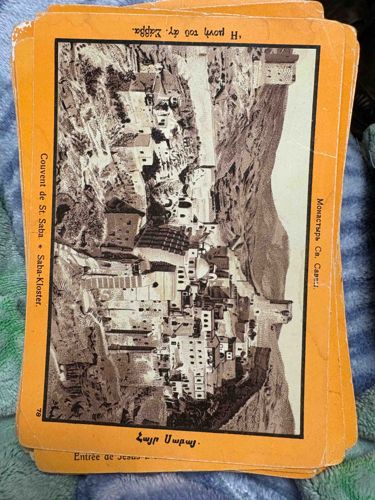
Bulgaria almost 100 cards

AI analysis below

AI appraisal

AI analysis & estimate

AI-Generated · Verify before acting

Everything below is generated by AI for informational purposes only. AI can make mistakes — the AI may misidentify items or misattribute them (artist, maker, brand, designer, origin, era). This is not an official valuation and should not be used for insurance, sale, tax, estate, legal, or lending purposes — or any decision requiring a certified appraisal. It is not an authoritative claim about any person, brand, or rights holder — do not share or rely on it as a factual statement about a third party. Always consult qualified professionals before making financial decisions.

Note

This analysis also relies on unverified notes provided by the user, which may be incomplete or inaccurate and could affect the result.

Read the full disclaimer

AI Identification

·Not independently authenticated·Verify before acting

Vintage Multilingual Postcard of Mar Saba (Saint Sabbas) Monastery

Antique & Vintage Postcards

AI Estimated Value

·Not an official valuation·Verify before acting

$15.00 - $25.00

As of June 6, 2026

AI Item Analysis

·AI can make mistakes·Verify before acting
This is a vintage postcard depicting the Mar Saba (Saint Sabbas) Monastery, a Greek Orthodox monastery overlooking the Kidron Valley. The card features a sepia-toned or greyscale photographic print framed by a prominent orange or saffron-colored border. A notable characteristic is the multilingual captions identifying the location: Greek (top), Russian (right), French and German (left), and Armenian (bottom), suggesting it was produced for international distribution or pilgrims in the Holy Land. The construction is standard cardstock with rounded corners typical of the early to mid-20th century. Condition issues are visible, including significant corner wear, edge fraying (particularly on the left and top edges), and a crease across the upper right portion of the image. The stacking indicates it is part of a larger collection of approximately 100 cards from Bulgaria. The printing style is half-tone lithography, common for topographical souvenirs from the 1910s to the 1940s. The quality of the central image reflects standard commercial photography of that era, focused on architectural and landscape documentation.

AI Appraisal Report

·AI can make mistakes·Verify before acting
I have completed a visual assessment of the vintage postcard depicting the Mar Saba Monastery. Based on the halftone lithographic printing and the distinctive multi-lingual captions (Greek, Russian, French, German, and Armenian), I date this piece to the 'Golden Age' of postcards, likely circa 1910-1925. This multilingual format indicates it was produced by a high-end publisher catering to the diverse religious pilgrims visiting the Holy Land. The subject matter—a significant Greek Orthodox site—remains consistently popular with Holy Land collectors and religious history enthusiasts. However, condition is a primary factor in the valuation of paper ephemera. My examination reveals significant wear: blunted and frayed corners, edge chipping, and a prominent crease in the upper-right quadrant. Such structural defects significantly diminish the value compared to 'Mint' or 'Fine' examples. While the card is authentic to its era, current market demand for common topographical views in this condition is modest. Individual cards of this type typically realize between $15 and $25 at auction; the broader collection of 100 Bulgarian cards mentioned may have a higher cumulative value depending on their specific themes. Authenticity is determined here by the typography and printing patterns visible in the digital file. A full authentication would require an in-person macroscopic inspection to verify paper fiber density, ink absorption, and any hidden repairs. Provenance documentation, such as family records or original purchase receipts from the early 20th century, would further solidify its history. Without physical handling, it is impossible to definitively confirm the presence of chemical foxing or the acidity level of the cardstock.

Get your items appraised

Instant estimates of your treasures with AI-powered appraisals

Browse More Appraisals