AI estimate as of August 31, 2025 · verify with a professional before acting
AI-Generated · Verify before acting
Everything on this page is generated by AI for informational purposes only. AI can make mistakes — the AI may misidentify items or misattribute them (artist, maker, brand, designer, origin, era). This is not an official valuation and should not be used for insurance, sale, tax, estate, legal, or lending purposes — or any decision requiring a certified appraisal. It is not an authoritative claim about any person, brand, or rights holder — do not share or rely on it as a factual statement about a third party. Always consult qualified professionals before making financial decisions.
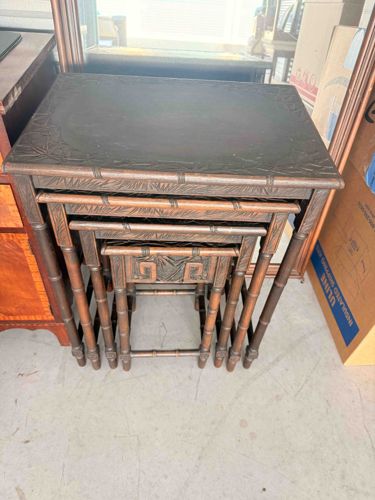
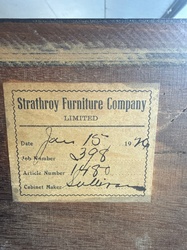
This is a set of four nesting tables, crafted from what appears to be a dark-stained wood, possibly oak or a similar hard brown wood, given its common use in furniture of the estimated period. The finish is a deep, rich brown, showing some areas of wear and minor scratching consistent with age and use, indicative of a developed patina rather than significant damage. The most distinctive feature is the extensive 'bamboo' turned and carved details on the legs and cross supports, mimicking the segmented structure of bamboo stalks. The tops of the tables are square or rectangular with rounded corners, and the edges feature a carved or molded detail that also suggests a bamboo-like texture. The largest table's top surface appears to have a contrasting, darker inset panel, possibly leather or a similar material, with decorative tooling or carving along its perimeter, likely a floral or scroll motif. The smaller tables, when viewed from the interior, reveal a carved frieze or apron with geometric and possibly stylized foliate patterns, reminiscent of Chinoiserie or Aesthetic Movement designs. The visible craftsmanship suggests solid construction and attention to detail. This set likely dates from the late 19th to early 20th century, possibly during the Aesthetic Movement or Arts and Crafts period, when 'bamboo' furniture and influences from Asian design were popular. There are no obvious maker's marks visible in the image, but the quality of the carving and construction suggests a reputable furniture maker. The tables nest perfectly, indicating precise manufacturing and design.
AI Appraisal Report
Upon visual examination of the provided image, this set of four bamboo-carved nesting tables presents as a well-preserved example of late 19th or early 20th-century furniture, likely from the Aesthetic Movement or Arts and Crafts period. The dark-stained wood, possibly oak, shows a desirable patina with minor signs of wear and scratching consistent with its age, indicating careful use rather than neglect. The distinguishing 'bamboo' turning and carving, along with the detailed frieze on the smaller tables and the contrasting inset panel on the largest, speak to skilled craftsmanship. This level of detail suggests a reputable manufacturer, though no maker's marks are visible, which is a common limitation with image-based appraisals.
In terms of market conditions, nesting tables from this period, especially those with unique carved details and good condition, are consistently sought after by collectors interested in period furniture, Chinoiserie, or Aesthetic Movement pieces. Comparables indicate that sets in good condition, authenticated by provenance or in-person inspection, can fetch higher prices. The demand for well-crafted, historically significant furniture remains stable, and the rarity of a complete, well-preserved set like this adds to its appeal. The precise nesting functionality further confirms quality manufacturing.
Limitations in authenticity verification exist solely from images. A definitive assessment would require in-person examination to verify wood species, construction techniques, and to search for hidden maker's marks. Provenance documentation (e.g., prior ownership, sales records) would further strengthen the authenticity claim. Scientific testing, while possible, is generally not required for furniture unless the materials themselves are in question. Based on the visual evidence, I estimate the value to be in the range of $600-900.