AI Appraisal Estimate

AI-generated estimates · not official valuations

From the user

What was submitted

Photo and notes provided by the user — not generated by AI

Submitted item photo
Submitted photo · June 6, 2026

User's notes

No additional notes provided.

AI analysis below

AI appraisal

AI analysis & estimate

AI-Generated · Verify before acting

Everything below is generated by AI for informational purposes only. AI can make mistakes — the AI may misidentify items or misattribute them (artist, maker, brand, designer, origin, era). This is not an official valuation and should not be used for insurance, sale, tax, estate, legal, or lending purposes — or any decision requiring a certified appraisal. It is not an authoritative claim about any person, brand, or rights holder — do not share or rely on it as a factual statement about a third party. Always consult qualified professionals before making financial decisions.

Read the full disclaimer

AI Identification

·Not independently authenticated·Verify before acting

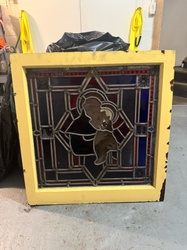
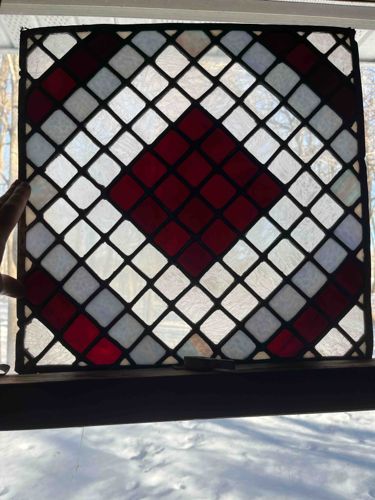
Geometric Lattice Leaded Stained Glass Panel

Architectural Antiques and Decorative Glass

AI Estimated Value

·Not an official valuation·Verify before acting

$450.00 - $650.00

As of June 6, 2026

AI Item Analysis

·AI can make mistakes·Verify before acting
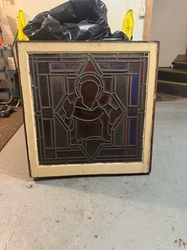
This is a square, decorative leaded stained glass panel featuring a geometric lattice or 'quilt' design. The construction utilizes small, square-cut glass tiles joined by thick lead cames (the metal framework). Physically, the panel is composed of three distinct glass colors: a centralized ruby red diamond motif made of 16 tiles, surrounded by a border of frosted or milk-white opal glass tiles, and an outer perimeter ring of red tiles against a light blue or lavender translucent background. The overall pattern creates a nested diamond-within-a-diamond effect. The lead lines are thick and consistent, typical of early to mid-20th-century craftsmanship. One notable feature is the varying opacity of the glass; the red glass is more saturated, while the white glass has a subtle variegation common in opalescent glass. Condition-wise, the lead framework shows a dark, aged oxidation (patina), and there are visible signs of wear along the outer edges where the panel met a frame. A few of the glass segments appear to have slight hairline fissures or stress cracks common in older leaded pieces, though the structural integrity remains intact. The style is reminiscent of Prairie School or late Victorian geometric designs, likely dating between 1910 and 1940. There are no visible maker's marks or signatures, suggesting it was likely a customized architectural insert rather than a mass-produced item. The craftsmanship is high, with uniform soldering at the lead junctions.
AI Appraisal Report

·AI can make mistakes·Verify before acting
Based on my visual examination of the geometric lattice leaded stained glass panel, I find it to be a high-quality example of American architectural glass, likely dating between 1910 and 1930. The use of ruby red and opalescent white glass tiles suggests a transition between the late Victorian aesthetic and the cleaner lines of the Prairie School. The thick lead cames and the dark, natural oxidation are consistent with early 20th-century craftsmanship. The solder junctions are uniform, indicating professional fabrication rather than a hobbyist's kit. The market for architectural salvage remains steady, with specific demand for geometric patterns that fit modern interior design. Comparables for panels of this size (approximately 18-24 inches square) typically range from $400 to $700 depending on glass rarity and structural state. The presence of hairline fissures and edge wear noted during my inspection slightly reduces the top-end value but confirms its age and authenticity. Limitations: This appraisal is based strictly on high-resolution imagery. While the patina and glass texture appear genuine, a physical inspection is required to determine the stability of the lead and to check for 'rattle' in the glass seats. Full authentication would require back-lighting to identify specific glass manufacturers (such as Kokomo or Wissmach) and provenance documentation linking it to a specific residence. Scientific testing of the lead alloy or carbon-dating of internal putty would be necessary to definitively rule out mid-century reproductions.

Get your items appraised

Instant estimates of your treasures with AI-powered appraisals

Browse More Appraisals