AI estimate as of August 30, 2025 · verify with a professional before acting
AI-Generated · Verify before acting
Everything on this page is generated by AI for informational purposes only. AI can make mistakes — the AI may misidentify items or misattribute them (artist, maker, brand, designer, origin, era). This is not an official valuation and should not be used for insurance, sale, tax, estate, legal, or lending purposes — or any decision requiring a certified appraisal. It is not an authoritative claim about any person, brand, or rights holder — do not share or rely on it as a factual statement about a third party. Always consult qualified professionals before making financial decisions.
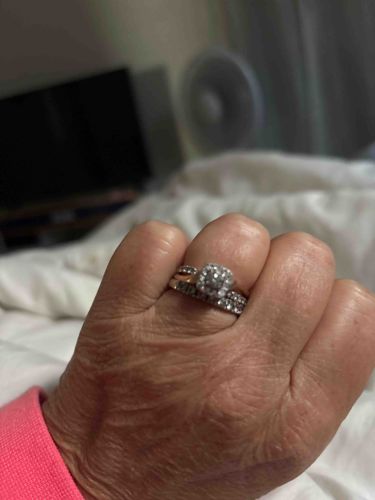
The item appears to be a two-piece bridal ring set, likely a wedding band and an engagement ring, worn on the ring finger of the left hand. The engagement ring features a prominent round-cut center stone, possibly a diamond, surrounded by a halo of smaller, pave-set stones, which creates a larger, more impactful appearance. The band of this ring also appears to be adorned with small stones, extending down the shoulders. The wedding band, worn underneath the engagement ring, is a straight band also set with numerous small, pave-set stones across its visible surface. The metal of the rings appears to be a mix of gold tones; the engagement ring's main setting and the stone accents may be in a white metal (e.g., white gold or platinum) to enhance the brilliance of the stones, while the underlying bands of both rings seem to have a warmer gold tone (yellow or rose gold). The craftsmanship suggests a popular contemporary style, emphasizing sparkle through multiple small stones. Based on the visible wear on the wearer's hand, the rings appear to be well-loved and regularly worn. There are no clear visible manufacturer's marks or specific style period indicators beyond a general contemporary aesthetic. The condition of the rings themselves, such as stone security or metal integrity, cannot be fully assessed from this image, but they appear to be in good, worn condition for daily use. The emphasis on pave and halo settings suggests a modern design, likely from the last 20-30 years.
AI Appraisal Report
Based on my visual examination of the provided image, I assess this bridal ring set to be in good, worn condition consistent with daily use. The emphasis on pave and halo settings suggests a modern design, likely from the last 20-30 years. Authenticity cannot be definitively confirmed from an image alone; however, the style appears genuine for contemporary mass-market or custom-made jewelry.
Market conditions for this style of bridal set are robust, with high demand for accessible luxury. Comparable items typically feature a prominent central stone, often a diamond or high-quality simulant, surrounded by a halo and pave-set accents. The presence of a warmer tone for the main bands (yellow or rose gold) and a white metal for the settings (likely white gold or platinum) is a popular contemporary trend. Given the visual impact of the sparkle, the stones are likely natural diamonds of commercial quality, or high-quality moissanite/lab-grown diamonds, which significantly influence value. The 'well-loved' appearance suggests it is a daily-worn set, indicating durability.
Factors significantly impacting value include the carat weight, cut, color, and clarity of the central stone, as well as the total carat weight and quality of the accent stones. The metal type is also a key determinant; platinum would command a higher value than 14K or 10K gold. Without specific details on these factors, my valuation is based on similar sets from online and retail markets, assuming commercial-grade materials. The widespread popularity of this design mitigates rarity, but demand remains high.
Limitations in authenticity verification are significant. Without in-person examination, I cannot verify the specific type or quality of the stones (natural vs. lab-grown vs. simulant), the metal purity, or identify any manufacturer's marks. For full authentication and a more precise valuation, an in-person examination by a gemologist is essential to perform precise measurements, weight assessment, stone testing (e.g., thermal conductivity, refractive index), and metal analysis. Provenance documentation (e.g., original sales receipts, gemological certificates) would also be highly beneficial.