These notes were written by the person who submitted this item. Appraiser.AI has not verified them, and the AI's identification and estimate may rely on them.
AI Estimated Value
Not an official valuation
$600-900
AI estimate as of August 22, 2025 · verify with a professional before acting
AI-Generated · Verify before acting
Everything on this page is generated by AI for informational purposes only. AI can make mistakes — the AI may misidentify items or misattribute them (artist, maker, brand, designer, origin, era). This is not an official valuation and should not be used for insurance, sale, tax, estate, legal, or lending purposes — or any decision requiring a certified appraisal. It is not an authoritative claim about any person, brand, or rights holder — do not share or rely on it as a factual statement about a third party. Always consult qualified professionals before making financial decisions.
This analysis also relies on unverified notes provided by the user, which may be incomplete or inaccurate and could affect the result.
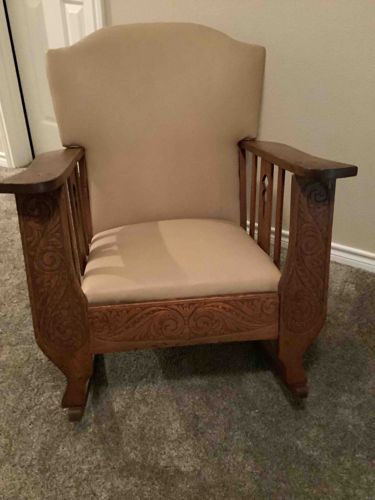
This is an antique or vintage wooden rocking chair, likely constructed from a rich, reddish-brown wood that appears to be oak or possibly a 'tiger wood' as suggested by the context, given its distinctive grain patterns. The chair features a high back with a gently curved crest rail and a broad, inviting seat, both upholstered in a plain, light beige fabric. The upholstery shows signs of use with slight compression, especially on the seat cushion, but no obvious tears or major stains are visible in the provided image.
The most striking features are the elaborately carved armrests and front stretcher. The armrests are broad and flat, providing a substantial resting surface, and their outer surfaces are adorned with intricate, deeply carved patterns, including swirling motifs and stylized floral or foliate elements typical of late 19th to early 20th-century craftsmanship, reminiscent of Art Nouveau or Mission style influences. The front stretcher connecting the two front legs also features matching detailed carvings, further enhancing the chair's decorative appeal. The side supports under the armrests consist of vertical wooden slats, some appearing to have small, stylized cut-outs or openings, adding to the period aesthetic. The chair is distinguished as a rocking chair by the curved runners visible at the base, designed for a smooth rocking motion.
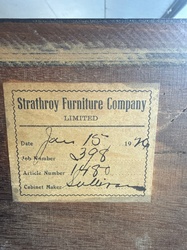
Overall, the wood appears to have a consistent, aged patina, suggesting long-term care, though there might be minor surface wear consistent with its age. There are no obvious manufacturing marks or signatures discernible from the image. The quality of the carving indicates skilled craftsmanship, and the robust construction suggests it was built for durability. The combination of the sturdy wooden frame, detailed carvings, and upholstered comfort points to a chair designed for both aesthetic appeal and practical use within a home setting, possibly originating from the Arts and Crafts or Art Nouveau period (circa 1890-1920s).
AI Appraisal Report
This carved wooden rocking chair, likely American and dating from the late 19th to early 20th century, presents as a well-preserved example of period furniture. The reddish-brown wood, identified by the owner as 'tiger wood' (a commonly used marketing term for quarter-sawn oak with strong medullary rays), exhibits a consistent patina, endorsing its age. The condition appears to be very good; while the upholstery shows minor compression consistent with use, there are no visible tears or major stains from the image. The intricate carvings on the armrests and front stretcher are well-executed, suggesting skilled craftsmanship, aligning with Arts and Crafts or possibly early Art Nouveau aesthetics.
Market comparables for elaborately carved oak rocking chairs from this period typically range widely based on condition, wood quality, and carving intricacy. While 'tiger wood' can be attractive, it does not inherently command a premium over other quartersawn oak pieces unless from a particularly renowned maker. Demand for antique rocking chairs is steady but not surging. The lack of visible maker's marks or signatures limits the potential for a higher-tier valuation.
Factors significantly impacting value include the chair's good overall condition and the distinctive carving. However, without in-person examination, I cannot verify the structural integrity of the joints, the condition of the rocking mechanism, or identify any hidden repairs or restorations. Authenticity can only be fully verified by physical inspection, which would allow for detailed examination of joinery, wood grain patterns, and any potential hidden marks. Provenance documentation could also significantly impact the value by confirming its history or attribution to a specific workshop or designer.