These notes were written by the person who submitted this item. Appraiser.AI has not verified them, and the AI's identification and estimate may rely on them.
AI Estimated Value
Not an official valuation
$40-60
AI estimate as of July 28, 2025 · verify with a professional before acting
AI-Generated · Verify before acting
Everything on this page is generated by AI for informational purposes only. AI can make mistakes — the AI may misidentify items or misattribute them (artist, maker, brand, designer, origin, era). This is not an official valuation and should not be used for insurance, sale, tax, estate, legal, or lending purposes — or any decision requiring a certified appraisal. It is not an authoritative claim about any person, brand, or rights holder — do not share or rely on it as a factual statement about a third party. Always consult qualified professionals before making financial decisions.
This analysis also relies on unverified notes provided by the user, which may be incomplete or inaccurate and could affect the result.
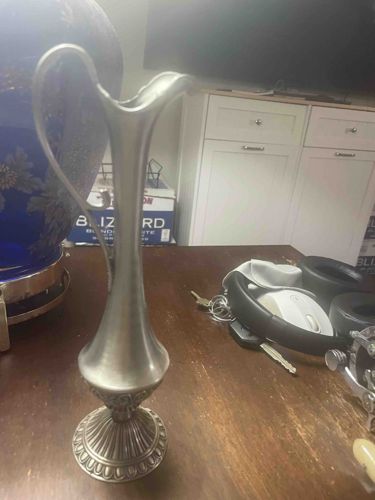
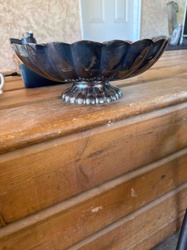
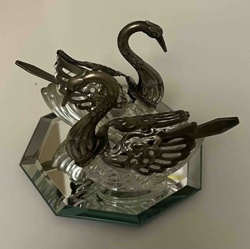
This item is a slender, elegant pewter pitcher or ewer, exhibiting a soft, matte grey finish characteristic of aged pewter, with no apparent bright spots or polished areas. Its overall form is tall and attenuated, featuring a dramatically flared rim that forms a distinct spout on one side, opposing a gracefully arching handle. The body of the pitcher is curvilinear, starting narrowly at the top, widening gently, and then rapidly tapering to a bulbous section before flaring out again to form a substantial, ornate base. The base is circular and features a series of vertical fluted or reeded patterns radiating from the center, encircled by a band of relief-molded foliate or scrollwork decoration. The transition from the body to the base is accentuated by a smaller, similarly ornate band of decoration. There are no visible maker's marks, signatures, or stamps evident in the provided images, suggesting either a lack of such markings, or their placement in an unseen area (e.g., the base underside). The surface appears to have a natural patina consistent with age, with no significant dents, cracks, or repairs visible. The craftsmanship suggests a cast or spun metal construction, with the decorative elements likely cast in relief. Given the material and the decorative style, it could potentially date from the late 19th to mid-20th century, possibly in an Art Nouveau or Art Deco-inspired aesthetic, although a definitive period is challenging without further details or markings. The design is somewhat stylized and ornamental, indicating a decorative rather than purely utilitarian purpose.
AI Appraisal Report
Upon examination of the provided images, this pewter ewer presents as a well-preserved decorative piece. The item's condition appears very good, with a consistent, natural patina and no major visible defects such as dents, cracks, or significant scratches. The ornate base, featuring fluted patterns and foliate scrollwork, suggests a design from the late 19th to mid-20th century, possibly influenced by Art Nouveau or Art Deco revival styles. The absence of any visible maker's marks is a significant factor. While some unmarked pewter can be high quality, identifiable makers often command higher prices. The market for unmarked decorative pewter is generally modest. Comparable unmarked ewers of similar size and decorative complexity typically sell in the secondary market for under $100. Demand is steady but not particularly high unless attributed to a renowned designer or manufacturer like Liberty & Co. or WMF. Its primary value driver is its decorative appeal rather than rarity or historical significance. It is important to note that a full assessment of authenticity and condition is limited by the digital images. An in-person examination would be required to search for hidden marks on the underside of the base, assess the metal's weight and composition, and detect any subtle repairs not visible in photos.