AI Appraisal Estimate

AI-generated estimates · not official valuations

From the user

What was submitted

Photo and notes provided by the user — not generated by AI

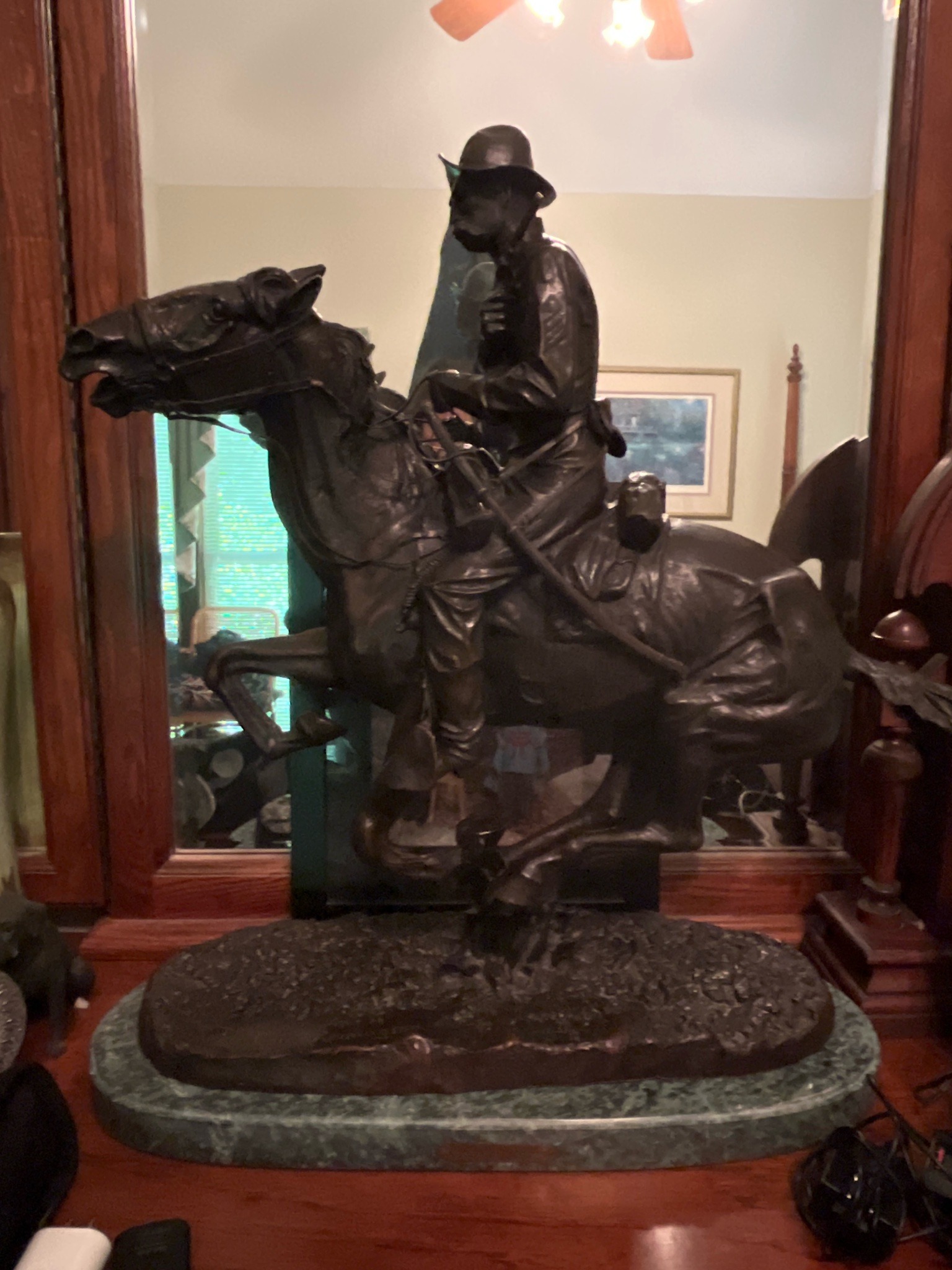
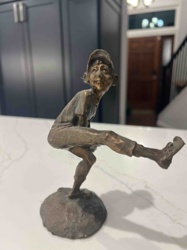
Submitted item photo
Submitted photo · June 23, 2026

User's notes

Trooper of the plains

AI analysis below

AI appraisal

AI analysis & estimate

AI-Generated · Verify before acting

Everything below is generated by AI for informational purposes only. AI can make mistakes — the AI may misidentify items or misattribute them (artist, maker, brand, designer, origin, era). This is not an official valuation and should not be used for insurance, sale, tax, estate, legal, or lending purposes — or any decision requiring a certified appraisal. It is not an authoritative claim about any person, brand, or rights holder — do not share or rely on it as a factual statement about a third party. Always consult qualified professionals before making financial decisions.

Note

This analysis also relies on unverified notes provided by the user, which may be incomplete or inaccurate and could affect the result.

Read the full disclaimer

AI Identification

·Not independently authenticated·Verify before acting

Trooper of the Plains Bronze Sculpture after Frederic Remington

Fine Art - Bronze Sculpture

AI Estimated Value

·Not an official valuation·Verify before acting

$500 - $800

As of June 23, 2026

AI Item Analysis

·AI can make mistakes·Verify before acting
This is a bronze casting of the famous sculpture 'Trooper of the Plains,' originally designed by the American artist Frederic Remington in 1907. The piece depicts a US Cavalry soldier riding a galloping horse with all four hooves appearing to leave the ground, a signature of Remington's dynamic style. The sculpture is rendered in a dark chocolate brown patina with subtle highlights on the raised surfaces. The horse exhibits intense movement with an open mouth and strained musculature, while the trooper is detailed with a campaign hat, uniform, and a sheathed saber. The bronze figure is mounted on an integral bronze base with a rugged, textured surface that simulates the plains, which in turn is set upon a contoured green marble plinth. This particular example appears to be a high-quality later reproduction or 'estate' casting, likely from the mid-to-late 20th century. The craftsmanship is evident in the textural details of the horse's mane and the trooper's gear, though it lacks the specific foundry marks visible in this angle to confirm a specific edition. The condition appears excellent with a well-preserved patina, showing no visible signs of metal fatigue or significant pitting, though light surface dust is present.
AI Appraisal Report

·AI can make mistakes·Verify before acting
Based on my visual examination of the provided images, this is a bronze casting of 'Trooper of the Plains,' after the original 1907 design by Frederic Remington. The piece features a dark chocolate brown patina and is mounted on a contoured green marble plinth. The dynamic composition, showing a cavalry soldier on a galloping horse, captures Remington's signature style. However, based on the details, base, and overall casting quality, this appears to be a mid-to-late 20th-century later reproduction or 'estate' casting rather than a lifetime cast. The condition appears very good, with a well-preserved patina and no obvious structural damage visible in the provided image. In the current market, posthumous and later reproductions of Remington bronzes are common and generally serve as decorative pieces. Demand is steady among collectors of Western decor, but values are modest compared to authentic, authenticated lifetime casts by foundries like Roman Bronze Works. Comparable later castings of this size and quality typically sell at auction in the $500 to $800 range, depending on the exact dimensions, weight, and specific foundry marks, if any. Please note that this appraisal is based solely on photographic evidence. A definitive authentication and exact valuation would require an in-person inspection to examine the casting method, weight, underside, and any concealed foundry marks or signatures. Provenance documentation would also be necessary to establish a complete history.

Get your items appraised

Instant estimates of your treasures with AI-powered appraisals

Browse More Appraisals