AI estimate as of August 1, 2025 · verify with a professional before acting
AI-Generated · Verify before acting
Everything on this page is generated by AI for informational purposes only. AI can make mistakes — the AI may misidentify items or misattribute them (artist, maker, brand, designer, origin, era). This is not an official valuation and should not be used for insurance, sale, tax, estate, legal, or lending purposes — or any decision requiring a certified appraisal. It is not an authoritative claim about any person, brand, or rights holder — do not share or rely on it as a factual statement about a third party. Always consult qualified professionals before making financial decisions.
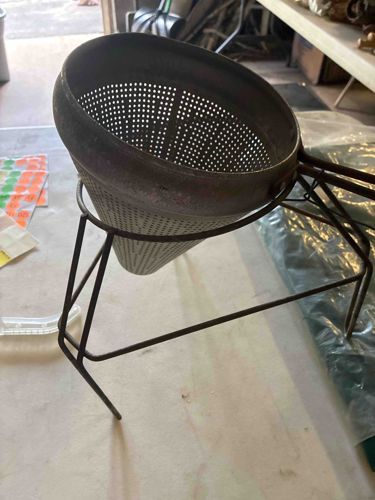
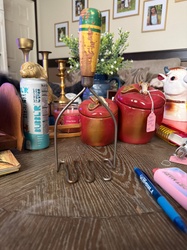
This item is an antique or vintage-style food mill, commonly known as a 'sieve' or 'food strainer with stand,' designed for processing fruits and vegetables. It consists of two primary components: a large, conical, perforated metal hopper/sieve and a separate wire metal stand. The hopper appears to be constructed from a dark, oxidized metal, possibly tin-plated steel or aluminum, showing a considerable amount of wear and a dark, aged patina. The perforations are uniform, small, circular holes distributed throughout the conical shape, essential for separating pulp from skins and seeds. The top rim of the cone is reinforced with a rolled edge, suggesting sturdy construction. Visible condition issues include surface discoloration, scratching, and general wear consistent with age and use; there are no obvious signs of significant damage like dents or cracks, but the surface finish is far from new. Attached to the side of the conical sieve are two metal rods, likely part of a handle or a mechanism for rotation, although the actual crank or pressing mechanism is not visible in the image. The stand is made of dark, slender wire metal, bent into a stable, angular shape with multiple points of contact to support the conical sieve. The stand's dark finish matches the patina of the sieve, indicating they are likely original companions. The wire construction of the stand provides a minimalistic yet functional support, allowing the sieve to be elevated for catching processed food in a bowl underneath. The overall aesthetic suggests a robust, utilitarian kitchen tool from the mid-20th century or earlier, built for durability rather than decorative appeal. The craftsmanship appears to be functional and straightforward, typical of mass-produced kitchen tools of that era.
AI Appraisal Report
Upon examining the Vintage Conical Food Mill with Stand, my assessment indicates it is an authentic utilitarian kitchen tool, likely dating from the mid-20th century. The dark, oxidized metal of both the hopper and the stand exhibits a consistent aged patina, suggesting they are original companions and have endured significant use. The rolled rim on the cone reinforces its sturdy construction, typical of tools designed for durability. While the surface shows considerable wear, scratching, and discoloration—all consistent with its age and intended function—there are no visible structural damages such as deep dents or cracks which would severely devalue the item. The absence of the crank mechanism is a detraction, as it renders the tool incomplete for its primary function.
Market conditions for vintage kitchenware, especially functional pieces, are generally stable, driven by collectors and enthusiasts seeking authentic period items or decorative accents. Comparables indicate similar, complete food mills of this era typically retail between $40-$80, depending on condition and completeness. Incomplete items naturally fetch less. Demand for such specific, utilitarian vintage items is moderate, primarily from niche collectors or those furnishing period-specific kitchens. Rarity is not a significant factor here; these mills were mass-produced. The missing crank significantly impacts its value, as it moves it from a functional antique to primarily a decorative or incomplete set piece.
It is important to note that a full, definitive authentication would require in-person examination to assess metal composition and construction details more thoroughly. Provenance documentation, though rare for such items, would also solidify its history. Scientific testing, like material analysis, would be overkill for an item of this value range but could confirm manufacturing period if needed.