AI Appraisal Estimate

AI-generated estimates · not official valuations

From the user

What was submitted

Photo and notes provided by the user — not generated by AI

Submitted item photo
Submitted photo · May 23, 2026

User's notes

No additional notes provided.

AI analysis below

AI appraisal

AI analysis & estimate

AI-Generated · Verify before acting

Everything below is generated by AI for informational purposes only. AI can make mistakes — the AI may misidentify items or misattribute them (artist, maker, brand, designer, origin, era). This is not an official valuation and should not be used for insurance, sale, tax, estate, legal, or lending purposes — or any decision requiring a certified appraisal. It is not an authoritative claim about any person, brand, or rights holder — do not share or rely on it as a factual statement about a third party. Always consult qualified professionals before making financial decisions.

Read the full disclaimer

AI Identification

·Not independently authenticated·Verify before acting

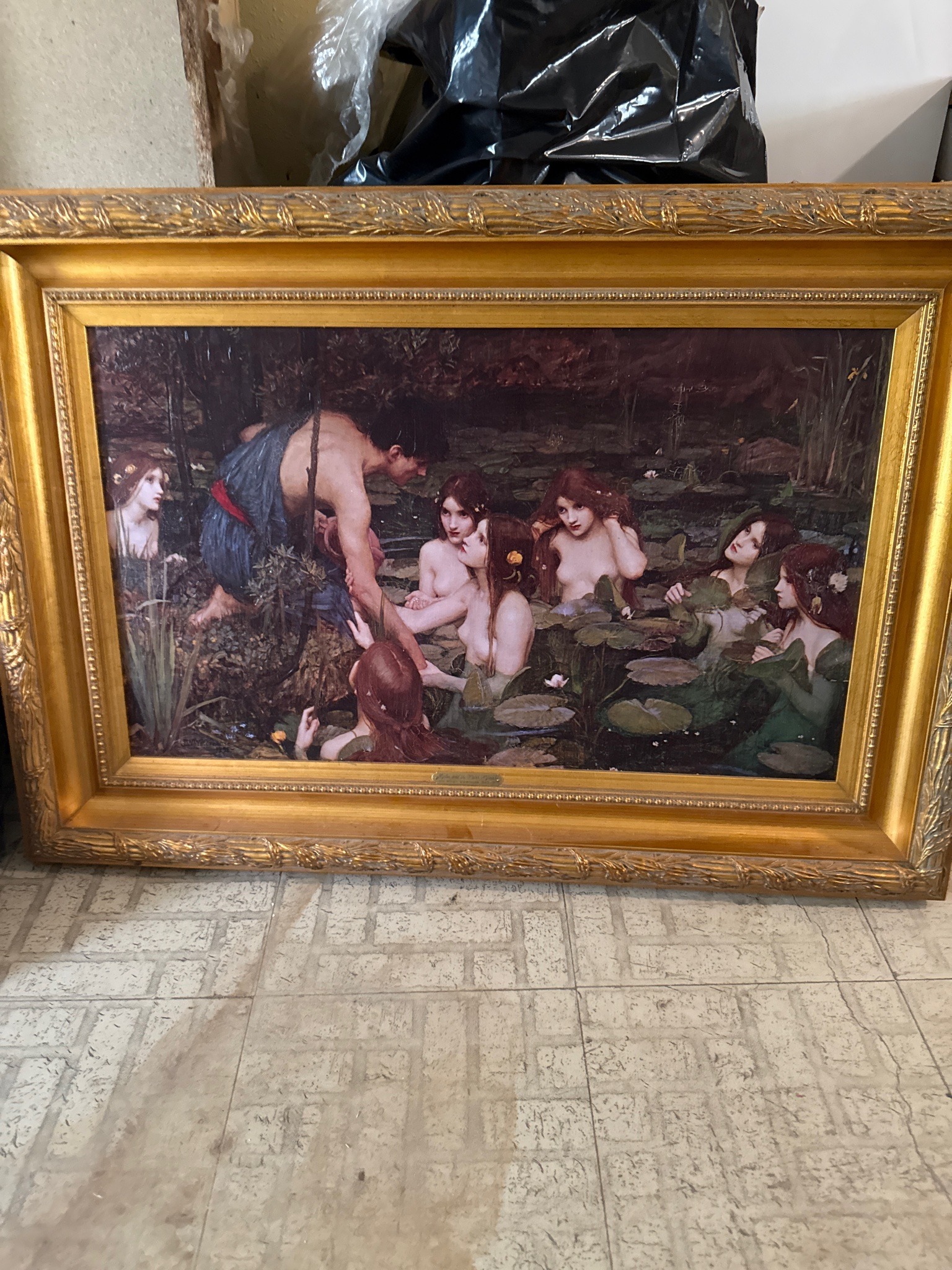
Pre-Raphaelite style figurative scene appearing to be after 'Hylas and the Nymphs' by John William Waterhouse

Art

AI Estimated Value

·Not an official valuation·Verify before acting

$400 - $1,200

As of May 23, 2026

AI Item Analysis

·AI can make mistakes·Verify before acting
This item is a framed illustrative work, stylistically consistent with the late Victorian Pre-Raphaelite movement. The central image depicts a young man, traditionally identified in this composition as Hylas, being lured into a pond by several water nymphs among lily pads. The color palette is dominated by dark, earth-toned swampy greens and browns, contrasted against the pale flesh of the female figures and the man’s blue garment with a red sash. The composition appears to be a rendition or reproduction of the 1896 painting 'Hylas and the Nymphs' by John William Waterhouse. A small gold-toned plaque is visible on the inner frame, though the text is not fully legible from this distance; it appears to note the title and artist consistent with Waterhouse. The work is housed in a large, ornate gilded frame featuring a laurel-leaf pattern and a deep cove profile. Without a physical inspection, it is impossible to determine if this is an oil painting, a giclée, or a vintage print. The surface appears matte and relatively flat in the photograph. The frame shows some minor dust accumulation and light wear, consistent with an item that has been stored or moved recently. The attribution remains a hypothesis subject to verification of the medium and the legitimacy of any signatures hidden by the frame or lighting.

AI Appraisal Report

·AI can make mistakes·Verify before acting
Based on my examination of the provided photograph, this work appears to be a rendition of John William Waterhouse’s 1896 masterpiece 'Hylas and the Nymphs.' The piece is presented in an ornate, gilded laurel-pattern frame that is consistent with late Victorian aesthetic preferences. While the composition and color palette align with the Pre-Raphaelite movement, I cannot verify the medium from this image alone. The flat, matte appearance suggests it could be a high-quality vintage print, a giclée, or potentially a hand-painted reproduction. The presence of a title plaque is a common feature for decorative replicas or museum-distributed editions. Because I cannot physically inspect the surface for brushwork, impasto, or age-appropriate canvas oxidation, I am treating this as a high-quality decorative reproduction rather than an autograph work. If this is a late 19th or early 20th-century oil-on-canvas copy, the value would sit at the higher end of the $400 - $1,200 range due to the craftsmanship and the quality of the substantial frame. However, if physical inspection reveals it to be a modern mechanical reproduction on paper or board, the value would likely fall below $150. Collectors of Pre-Raphaelite style art maintain a steady demand for such imagery, particularly when housed in period-appropriate framing. To arrive at a more precise valuation, a specialist would need to examine the item out of the frame to check for signatures, labels, or printing dots under magnification. Scientific testing of pigments or canvas weave and a search for documented provenance would be required to elevate this from a decorative hypothesis to a categorical attribution. This estimate assumes the work is a reputable decorator-level reproduction.

Get your items appraised

Instant estimates of your treasures with AI-powered appraisals

Browse More Appraisals