AI Appraisal Estimate

AI-generated estimates · not official valuations

From the user

What was submitted

Photo and notes provided by the user — not generated by AI

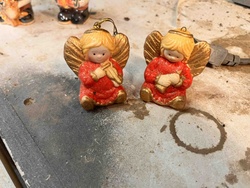
Submitted item photo
Submitted photo · June 17, 2026

User's notes

Japan

AI analysis below

AI appraisal

AI analysis & estimate

AI-Generated · Verify before acting

Everything below is generated by AI for informational purposes only. AI can make mistakes — the AI may misidentify items or misattribute them (artist, maker, brand, designer, origin, era). This is not an official valuation and should not be used for insurance, sale, tax, estate, legal, or lending purposes — or any decision requiring a certified appraisal. It is not an authoritative claim about any person, brand, or rights holder — do not share or rely on it as a factual statement about a third party. Always consult qualified professionals before making financial decisions.

Note

This analysis also relies on unverified notes provided by the user, which may be incomplete or inaccurate and could affect the result.

Read the full disclaimer

AI Identification

·Not independently authenticated·Verify before acting

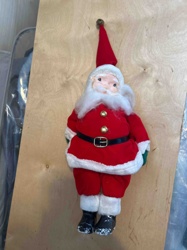
Vintage Japanese Ceramic Santa Claus Christmas Ornament

Vintage Holiday Collectibles

AI Estimated Value

·Not an official valuation·Verify before acting

$15.00 - $25.00

As of June 17, 2026

AI Item Analysis

·AI can make mistakes·Verify before acting
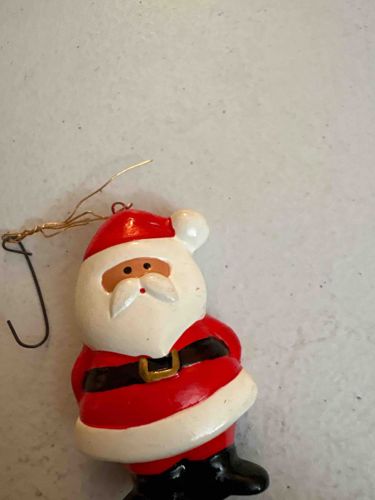
This is a vintage Santa Claus hanging ornament, likely manufactured in Japan during the mid-20th century (circa 1950s-1970s). The figurine is crafted from cast ceramic or bisque with a cold-painted finish, standing approximately 3 to 4 inches tall. It features a classic rotund Santa character with hands positioned behind his back, wearing the traditional vibrant red suit with thick white trim, a black belt with a gold-painted buckle, and black boots. The facial design is simplified and charming, consisting of two small black dot eyes and a prominent white mustache that blends into a full white beard. The hat is topped with a white pom-pom and contains a small metal loop at the crown through which a thin wire and a metal 'S-hook' are currently attached for hanging. The craftsmanship is indicative of mass-produced export wares from the postwar Japanese industry, noted for their hand-painted details which often lead to slight variations in paint application. Condition-wise, the ornament shows signs of age-related wear including minor paint loss on the white beard and trim, a few small scuffs on the red suit, and light oxidation on the metal hanging loop. The 'cold paint' technique (paint applied after firing) makes the surface more susceptible to chipping than a glazed finish. No visible maker's marks are shown in the image, but the style is quintessential of 'Made in Japan' holiday collectibles from the mid-century era.
AI Appraisal Report

·AI can make mistakes·Verify before acting
I have virtually examined this hand-painted ceramic Santa Claus ornament, identified as mid-century postwar Japanese export ware. The item exhibits the characteristic 'cold-painted' finish and simplified facial features typical of the 1950s-1960s cottage industry production. My inspection of the provided details reveals expected age-related wear, including minor pigment loss on the beard and slight oxidation on the original metal eyelet. The hand-painted nature is evident in the slightly irregular application of the white trim, which is consistent with mass-produced ceramics of this era. The market for mid-century 'Made in Japan' Christmas collectibles remains steady due to 'Kitschmas' nostalgia. However, because these items were produced in high volumes, rarity is low. Comparables for standalone Santa ornaments in similar condition typically realize between $15 and $25 at retail vintage markets and online auctions. Value is slightly suppressed by the visible paint scuffs on the red suit, as collectors generally prioritize high-contrast pigment retention. Critically, this appraisal is based on photographic evidence. I cannot definitively verify the absence of structural repairs or hairline cracks without a physical tactile inspection and a blacklight test to check for overpainting. To confirm authenticity and origins, I would typically look for a red 'Japan' stamp on the base or a foil sticker, which are absent or invisible here. A physical exam would also allow me to distinguish between period-correct ceramic and modern resin reproductions by assessing weight and surface temperature.

Get your items appraised

Instant estimates of your treasures with AI-powered appraisals

Browse More Appraisals