AI estimate as of October 26, 2025 · verify with a professional before acting
AI-Generated · Verify before acting
Everything on this page is generated by AI for informational purposes only. AI can make mistakes — the AI may misidentify items or misattribute them (artist, maker, brand, designer, origin, era). This is not an official valuation and should not be used for insurance, sale, tax, estate, legal, or lending purposes — or any decision requiring a certified appraisal. It is not an authoritative claim about any person, brand, or rights holder — do not share or rely on it as a factual statement about a third party. Always consult qualified professionals before making financial decisions.
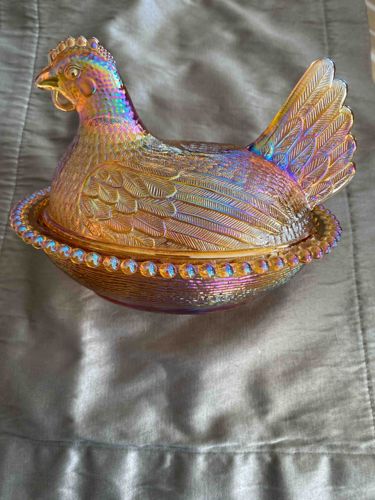
This item is an iridescent carnival glass hen-on-nest dish, a popular form of covered dishware often used for serving butter, candy, or storing small trinkets. The dish is crafted from molded glass, characterized by its distinctive iridescence, which displays a shifting spectrum of colors including gold, amber, purple, blue, and green, depending on the angle of light. This effect is a hallmark of carnival glass, achieved by applying metallic salts to the glass while it is still hot. The hen figure forms the lid and is intricately detailed with textured feathers, clearly defined wings, and a fanned tail. The head features a prominent comb, wattle, and an eye, all rendered with depth. The base of the dish is designed to resemble a nest, encircled by a raised, beaded rim that provides a decorative edge and secures the lid. The overall color palette is predominantly golden amber with strong purple and blue iridescent overtones, giving it a rich, antique appearance. The craftsmanship suggests a pressed glass manufacturing process, common for carnival glass pieces. No visible chips, cracks, or significant damage are apparent from the image, indicating good to excellent condition for its likely age. The iridescent finish appears well-preserved, without significant wear or dulling. The piece exhibits a consistent quality of molding and finish, characteristic of decorative pressed glass from the late 19th to early 20th century, specifically the height of the carnival glass era (circa 1900s-1930s). Its unique visual appeal and the detailed representation of the hen make it a charming collectible.
AI Appraisal Report
Based on my visual examination of the provided image, this iridescent carnival glass hen-on-nest dish demonstrates excellent condition for its age. I see no chips, cracks, or significant damage, and the iridescent finish appears remarkably well-preserved with vibrant golden amber, purple, blue, and green overtones, which is crucial for carnival glass valuation. The detailed molding of the hen's feathers, comb, and wattle, along with the nest base, confirms its decorative pressed glass manufacturing characteristic of the late 19th to early 20th century. Authenticity as a period carnival glass piece is strongly suggested by these visual cues, consistent with popular manufacturers of the era.
Market conditions for carnival glass hen-on-nest dishes are generally stable, with collector interest remaining steady. Comparable sales for similar pieces in excellent condition, particularly those with a strong iridescent sheen and popular colorways like this golden amber with prominent purples and blues, typically fall within the $75-$125 range. While not exceedingly rare, the condition and visual appeal of this specific piece elevate its desirability. The detailed craftsmanship and absence of flaws significantly impact its value upwards. Demand for well-preserved examples like this one contributes to its collectible status.
However, it is imperative to note the limitations of image-based appraisal. While the visual evidence strongly suggests authenticity and excellent condition, a definitive verification requires in-person examination. I would look for mold lines, specific glass characteristics (e.g., bubbles, striations), and tactile confirmation of the surface finish and iridescence. Provenance documentation, though not available here, could further strengthen authenticity claims. Without physical inspection, I cannot rule out the possibility of a exceptionally well-done reproduction, though the visual cues lean heavily towards a genuine antique piece.