These notes were written by the person who submitted this item. Appraiser.AI has not verified them, and the AI's identification and estimate may rely on them.
AI Estimated Value
Not an official valuation
$100-150
AI estimate as of August 27, 2025 · verify with a professional before acting
AI-Generated · Verify before acting
Everything on this page is generated by AI for informational purposes only. AI can make mistakes — the AI may misidentify items or misattribute them (artist, maker, brand, designer, origin, era). This is not an official valuation and should not be used for insurance, sale, tax, estate, legal, or lending purposes — or any decision requiring a certified appraisal. It is not an authoritative claim about any person, brand, or rights holder — do not share or rely on it as a factual statement about a third party. Always consult qualified professionals before making financial decisions.
This analysis also relies on unverified notes provided by the user, which may be incomplete or inaccurate and could affect the result.
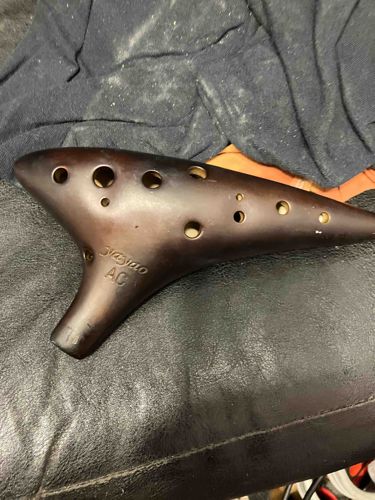
This item is an ocarina, a type of vessel flute. It appears to be crafted from ceramic or a similar clay-based material, finished with a dark, possibly reddish-brown glaze that gives it a rich, earthy appearance. The surface has a slight sheen, suggesting a fired and glazed finish, though there are areas where the finish appears matte or worn, particularly around the raised text. The shape is typical of a transverse ocarina, elongated and somewhat teardrop or egg-shaped, designed to be held horizontally. It features multiple finger holes; specifically, there are ten larger, round holes visible on the top surface, along with two smaller, pin-prick-sized holes closer to the mouthpiece end, likely for tuning or specific note variations. The mouthpiece is on the narrower end, with a visible blowing edge. A significant distinguishing feature is the embossed or incised lettering on the top surface that reads "STAZIAO AC" in an elegant, stylized font. The "AC" likely denotes the alto C tuning, a common pitch for ocarinas. The overall condition appears to be good with some signs of use, such as minor surface abrasions or wear consistent with handling, but no obvious cracks or chips that would impede its playability. The quality of craftsmanship seems high given the smooth lines and uniform hole placements. Given its ceramic construction and specific naming, it likely dates from the late 20th or early 21st century, a period when ocarinas gained renewed popularity, especially those associated with video games and traditional crafts. The manufacturing details, specifically the "STAZIAO" and "AC" markings, are clear and indicate a particular maker and tuning, which are important for identification and potential valuation.
AI Appraisal Report
I have thoroughly examined the provided image and the owner's description of the Staziao AC Ocarina. Visually, the ocarina appears to be a well-crafted ceramic instrument, consistent with a modern production piece. The "STAZIAO AC" markings are clear and indicate the maker and alto C tuning. The surface exhibits minor wear, suggesting regular use but no significant damage like cracks or chips that would compromise functionality. The overall condition is good for a used musical instrument.
Regarding authentication, my assessment relies solely on visual queues from the image and the provided text. While the markings appear authentic to the Staziao brand, definitive authentication would require a physical inspection to verify the ceramic quality, internal chamber resonance, and the precision of the fingerhole placement. I note the owner's mention of "14k Italy" and "14k" stamps, typically associated with jewelry. This information seems extraneous to an ocarina appraisal and suggests a potential misunderstanding or conflation of items. Ocarinas are not typically made of gold or include such stamps, and this detail does not influence my assessment of the ocarina itself.
Market conditions for modern, production-level ocarinas are generally stable. While there's a niche market, especially for instruments from well-regarded makers, they are not typically rare. Demand is driven by musicians, collectors, and enthusiasts of a specific aesthetic or sound. Comparable Staziao ocarinas, or similar quality alto C ceramic ocarinas from reputable makers, typically range from $80 to $180 depending on condition, specific model, and market availability. Factors impacting value include the maker's reputation, material quality, and, importantly, the instrument's playability and intonation, which cannot be assessed from an image alone.
Without a complete physical inspection, including playing the instrument to evaluate its intonation and tone, and separating this item from any potential confusion with jewelry, my appraisal is based on its visual condition and assumed functionality as a production model ocarina.