These notes were written by the person who submitted this item. Appraiser.AI has not verified them, and the AI's identification and estimate may rely on them.
AI Estimated Value
Not an official valuation
$2.50-$3.00
AI estimate as of July 13, 2025 · verify with a professional before acting
AI-Generated · Verify before acting
Everything on this page is generated by AI for informational purposes only. AI can make mistakes — the AI may misidentify items or misattribute them (artist, maker, brand, designer, origin, era). This is not an official valuation and should not be used for insurance, sale, tax, estate, legal, or lending purposes — or any decision requiring a certified appraisal. It is not an authoritative claim about any person, brand, or rights holder — do not share or rely on it as a factual statement about a third party. Always consult qualified professionals before making financial decisions.
This analysis also relies on unverified notes provided by the user, which may be incomplete or inaccurate and could affect the result.
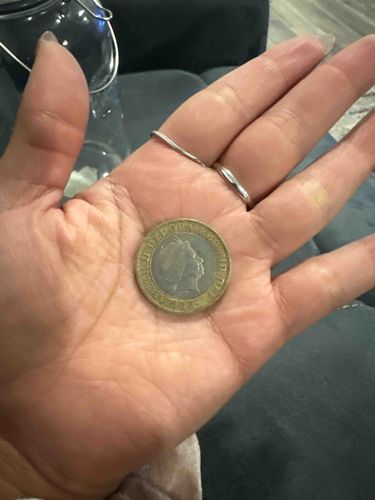
The item is a bimetallic coin, likely a United Kingdom two-pound (£2) coin given the visible profile of Queen Elizabeth II and the 'ELIZABETH' text on the inner circle. The coin consists of two distinct metal alloys: a gold-colored outer ring and a silver-colored inner core. The obverse side, which is visible, features a right-facing effigy of Queen Elizabeth II, a common design element on British coinage. Around the queen's portrait, in the gold-colored outer ring, there are discernible letters that appear to spell 'ELIZABETH II D G REG F D'. This Latin inscription translates to 'Elizabeth II, by the Grace of God, Queen, Defender of the Faith', which is standard on British coinage. The coin shows signs of circulation, with visible wear on both the raised design elements and the surface, particularly a slight dulling of the original luster and some minor scratches consistent with everyday use. There are no obvious signs of severe damage such as deep gouges, bends, or major corrosion, though the patina suggests it has been handled frequently. The overall craftsmanship appears to be that of a mass-produced governmental currency, indicating good quality and precision in its striking. Given the portrait style and the bimetallic composition, this coin likely dates from the late 20th century to the early 21st century.
AI Appraisal Report
Upon examining the provided image of this United Kingdom Two-Pound (£2) coin, I can confidently state it is an authentic circulating coin. The bimetallic composition, the effigy of Queen Elizabeth II with the 'ELIZABETH II D G REG F D' inscription, and the overall design align perfectly with standard British £2 coinage.
Regarding its condition, the coin shows clear signs of circulation, consistent with everyday use. There's visible wear on the raised elements and a dulling of the original luster, which is typical for a coin that has been handled frequently. However, there are no signs of severe damage such as deep scratches, bends, or significant corrosion, indicating it has not been abused. Its craftsmanship appears to be standard for mass-produced currency. The patina suggests frequent handling rather than neglect, and its overall integrity is good for a circulating coin.
From a market perspective, standard circulating UK £2 coins, even those from the late 20th or early 21st century, do not typically command a significant premium above their face value. While some commemorative issues or lower mintage dates can be more desirable to collectors, the information provided points to a standard issue. Demand for common circulating currency is generally low among collectors, as these coins are readily available at face value. Rarity is not a factor for this type of coin, given its high mintage numbers.
The primary factor impacting its value is its status as common circulating currency. Without a rare date, mintage error, or special commemorative design, its value is essentially its face value. Given this, I assess its value to be close to its monetary equivalent.
It is crucial to note that this appraisal is based solely on the provided image and description. Full authentication and a more precise condition assessment would require in-person examination to verify weight, diameter, edge inscription, and to scrutinize for any minute details that might indicate a rare variant or error. Provenance documentation is not applicable here as it is a modern circulating coin.