AI estimate as of August 23, 2025 · verify with a professional before acting
AI-Generated · Verify before acting
Everything on this page is generated by AI for informational purposes only. AI can make mistakes — the AI may misidentify items or misattribute them (artist, maker, brand, designer, origin, era). This is not an official valuation and should not be used for insurance, sale, tax, estate, legal, or lending purposes — or any decision requiring a certified appraisal. It is not an authoritative claim about any person, brand, or rights holder — do not share or rely on it as a factual statement about a third party. Always consult qualified professionals before making financial decisions.
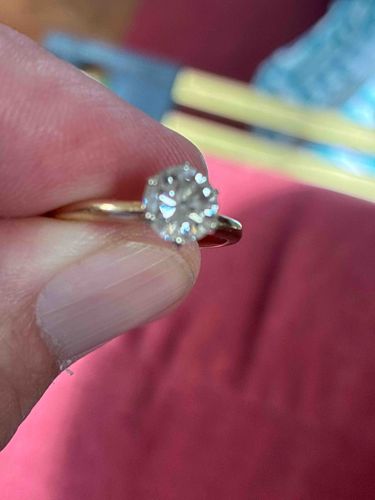
The item is a solitaire engagement ring, featuring a prominent round brilliant-cut diamond set in a classic six-prong setting. The band appears to be crafted from yellow gold, exhibiting a smooth, polished finish. The prongs securing the diamond are visibly silver-toned, likely white gold or platinum, providing a strong contrast against the warm yellow of the band and enhancing the white appearance of the diamond. The diamond itself exhibits significant brilliance and scintillation, indicative of good cut quality, and appears to be of considerable size. The band is relatively slender, complementing the diamond without overpowering it. The overall construction appears solid and well-executed, suggesting quality craftsmanship. There are no obvious signs of significant wear, damage, or repairs visible in the provided image; the metal appears free of deep scratches or dents, and the diamond seems securely mounted. Marks or signatures are not discernible from the image. The design is timeless and traditional, suggesting it could range from a vintage piece to a contemporary one, but its classic aesthetic points towards a style that has been popular for many decades, potentially dating from the mid-20th century to present. The simplicity of the design highlights the central stone, emphasizing its quality and brilliance.
AI Appraisal Report
Upon visual examination of the provided image, I assess this Solitaire Diamond Ring to be in excellent condition. The yellow gold band appears smooth and polished, free from any noticeable scratches, dents, or signs of wear. The six silver-toned prongs (likely white gold or platinum) securely hold the round brilliant-cut diamond, showing no signs of looseness or damage. The diamond exhibits impressive brilliance and scintillation, suggesting good cut quality, and its considerable size is a key value driver. The classic, timeless design emphasizes the central stone, indicating quality craftsmanship.
Market conditions for classic solitaire diamond rings remain consistently strong due to enduring demand. Comparables in the secondary market, assuming similar carat weight, color, and clarity, typically command a premium for well-maintained pieces. The simplicity and elegance of this design appeal to a broad demographic, ensuring steady demand. Rarity, in terms of unique design, is not a primary factor here due to its traditional styling; however, the quality of the diamond and the overall condition contribute significantly to its desirability and value. Factors significantly impacting value include the diamond's 4Cs (carat weight, cut, color, clarity), which I can only estimate visually, and the metal purity of the band.
It is crucial to note the limitations of appraising solely from an image. While the visual assessment of condition is positive, true authenticity verification beyond broad visual characteristics is not possible. I cannot definitively confirm the diamond's natural origin, specific 4Cs, or treatments without in-person examination using a loupe and other gemological tools, laboratory testing (e.g., GIA, AGS certification), and precise measurement. Similarly, the exact metal composition and hallmarks cannot be verified from the image. For a full authentication and precise valuation, physical inspection, detailed measurements, direct gemstone grading, and any available provenance documentation would be essential.