AI estimate as of August 26, 2025 · verify with a professional before acting
AI-Generated · Verify before acting
Everything on this page is generated by AI for informational purposes only. AI can make mistakes — the AI may misidentify items or misattribute them (artist, maker, brand, designer, origin, era). This is not an official valuation and should not be used for insurance, sale, tax, estate, legal, or lending purposes — or any decision requiring a certified appraisal. It is not an authoritative claim about any person, brand, or rights holder — do not share or rely on it as a factual statement about a third party. Always consult qualified professionals before making financial decisions.
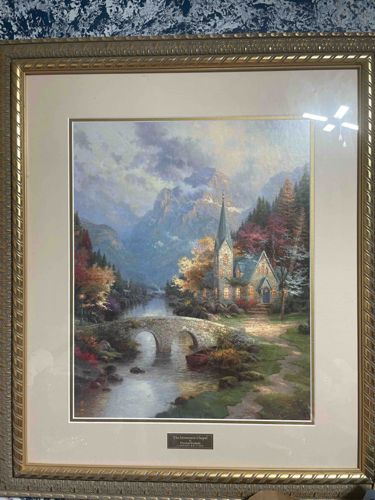
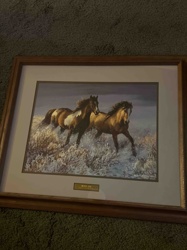
The item is a framed art print, likely a lithograph or giclée, featuring a picturesque landscape. The print depicts a stone chapel with illuminated windows, nestled beside a winding river crossed by an arched stone bridge. In the background, majestic mountains rise under a dramatic sky with hues of blue, gray, and purple, suggesting either dawn, dusk, or an overcast day. The surrounding foliage is vibrant with autumnal colors, including rusts, oranges, and greens, indicating a fall scene. The painting style is characteristic of Thomas Kinkade, known for his \"Painter of Light\" series, identifiable by the soft, glowing light emanating from the chapel and within the scene. The print is housed within a multi-layered matting arrangement, beginning with a thin gold fillet immediately surrounding the print, followed by a wider, cream-colored mat. This matting is in good condition with no visible stains or damage. The outer frame is a classic gold-toned ornate design with beaded and foliate motifs, showing some signs of wear and minor dust accumulation, but no significant chips or breaks. There is a small brass-colored plaque centered at the bottom of the mat, which appears to bear text, likely the title of the piece or artist's name, though the text is not clearly legible from the image. The overall condition of the print itself appears very good, with no visible fading, tears, or creases. Reflections on the protective glazing suggest it is likely glass or acrylic. The aesthetic aligns with late 20th to early 21st-century romantic landscape art, highly popular in the mass-market art reproductions.
AI Appraisal Report
Upon examining the provided image of the 'Autumnal Landscape Chapel by a River Framed Print,' I assess its condition as very good. The print itself shows no visible fading, tears, or creases. The multi-layered matting, with its gold fillet and cream surround, appears clean and intact. The ornate gold-toned frame, while exhibiting minor wear and dust accumulation consistent with age, has no significant damage. The protective glazing appears clear.
Authenticity: Based on the stylistic cues—the glowing light, idyllic landscape, and popular subject matter—this print is highly consistent with the commercial reproductions of Thomas Kinkade's work. The presence of a brass-colored plaque, common on Kinkade prints, further supports this. However, without a physical examination to check for an artist's signature (original or print), edition number (if applicable), 'DNA' markers, or COA, I cannot definitively confirm it as an authenticated Kinkade studio production or a later reproduction without direct provenance. Visual examination alone is insufficient for full authentication.
Market Conditions & Demand: Thomas Kinkade prints, particularly open editions or readily available lithographs, were mass-produced. While initially popular, secondary market demand for these items has softened considerably. They are not rare and often appear in estate sales and online marketplaces. Collectibility is limited, impacting value.
Value Factors: The primary value drivers for this piece are its decorative appeal, good condition, and professional framing. Its likely status as a reproduction rather than a limited edition, and the high volume of similar works on the market, significantly depress its secondary market value. Full authentication and provenance would significantly impact value, but that is not possible from images. Without knowing if it is an authenticated, numbered limited edition versus an open edition, the value is reflective of broad market supply.
For full authentication, a physical inspection is crucial to verify signatures, 'DNA' markings, and edition details. Provenance documentation (original purchase receipts, Certificates of Authenticity) and, in some rare cases, scientific analysis, would be ideal for a definitive assessment.