AI estimate as of December 1, 2025 · verify with a professional before acting
AI-Generated · Verify before acting
Everything on this page is generated by AI for informational purposes only. AI can make mistakes — the AI may misidentify items or misattribute them (artist, maker, brand, designer, origin, era). This is not an official valuation and should not be used for insurance, sale, tax, estate, legal, or lending purposes — or any decision requiring a certified appraisal. It is not an authoritative claim about any person, brand, or rights holder — do not share or rely on it as a factual statement about a third party. Always consult qualified professionals before making financial decisions.
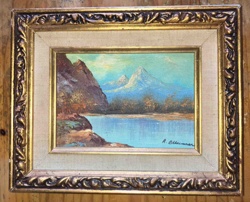
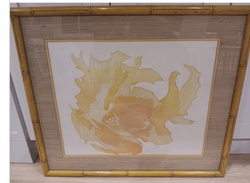
This item is a framed oil painting depicting a single lit candle set within a handled candlestick, rendered in a dark, atmospheric style. The central subject, the candle, is a creamy white or pale yellow color, with significant wax drippings visible along its sides, suggesting it has been burning for some time. The flame itself is bright orange and yellow, casting a warm, glowing halo that illuminates the immediate surroundings against an otherwise very dark background, likely mimicking a night scene or a dimly lit room. The candlestick appears to be made of a metallic material, possibly brass or copper, given its warm, reddish-brown hue and subtle sheen. It features a flat, circular base with a raised rim and a small, looped handle extending from one side, typical of designs intended for carrying. The candle is held in the center of this base by a small, elevated holder. The painting itself exhibits a noticeable texture, possibly indicating impasto technique, which gives depth and character to the surface. The brushwork appears somewhat loose yet effective in capturing the light and shadow. The painting is housed within a simple, light-colored wooden frame, likely pine or a similarly light-toned wood, with a smooth finish. There are no discernible maker's marks or signatures visible from the provided images. The condition of the painting appears stable, with no obvious signs of cracking or significant damage, though the visual quality of the image makes it difficult to assess fine details. The overall aesthetic suggests a traditional or classical still life approach, possibly from the 20th century, though an earlier origin cannot be entirely ruled out without further inspection. The dramatic lighting and solitary subject evoke a sense of quiet contemplation or a representation of light in darkness.
AI Appraisal Report
Based on my visual examination of the provided image of this oil painting depicting a lit candle on a candlestick, I assess its condition as stable, with no obvious signs of major damage such as cracks or flaking paint visible. The texture, possibly impasto, adds depth. Authenticity, however, is difficult to ascertain definitively from an image alone. The style suggests a traditional still life, potentially 20th-century, though earlier periods are plausible. The lack of visible signatures or maker's marks is a significant limitation.
Market conditions for unsigned fine art, particularly still life, can be varied. Comparable pieces by unknown artists, even well-executed ones, generally command lower prices than those with verifiable provenance or artist attribution. The dramatic lighting and atmospheric quality are appealing, which could contribute to demand among collectors of traditional art. Rarity is hard to determine without knowing the artist; similar candle paintings are common, but the artistic merit here is respectable. Factors impacting value include the lack of artist identification, which significantly limits market potential. However, its aesthetic appeal as a decorative piece is certainly a plus.
For full authentication and a more precise valuation, an in-person examination would be crucial. This would allow me to inspect the reverse of the canvas for any hidden marks, examine the paint layers and canvas support to confirm age and medium, and assess brushwork details. Provenance documentation, such as receipts or exhibition history, would be vital for attributing it to a specific artist or period. Scientific testing (e.g., pigment analysis, carbon dating) could offer further insights into its age and materials. Without these, the appraisal remains largely based on its decorative merit and general stylistic attributes.