AI estimate as of July 13, 2025 · verify with a professional before acting
AI-Generated · Verify before acting
Everything on this page is generated by AI for informational purposes only. AI can make mistakes — the AI may misidentify items or misattribute them (artist, maker, brand, designer, origin, era). This is not an official valuation and should not be used for insurance, sale, tax, estate, legal, or lending purposes — or any decision requiring a certified appraisal. It is not an authoritative claim about any person, brand, or rights holder — do not share or rely on it as a factual statement about a third party. Always consult qualified professionals before making financial decisions.
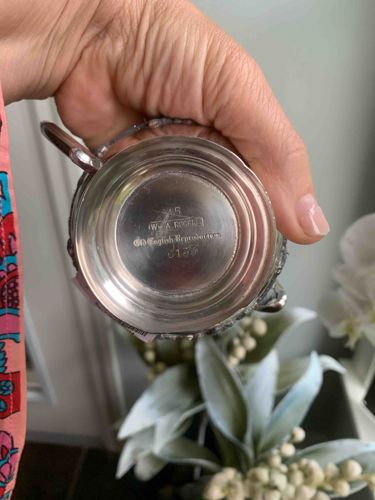
The item appears to be a small, circular, silver-toned metal object, likely a reproduction of a historical piece, as indicated by the 'English Reproduction' marking. The primary image focuses on the base of the item, revealing its manufacturing details. It is made of a reflective, metallic material, possibly silver-plated or a polished base metal, exhibiting a bright, somewhat uneven sheen. The construction shows a slightly convex base with concentric rings formed during the manufacturing process, indicating it might be a spun or turned piece.
The notable marking on the base clearly reads 'SW A ROYLE' (or possibly 'W.A. ROYLE'), 'English Reproduction', and 'J159'. The 'English Reproduction' inscription signifies that this item is not an original antique but rather a modern replica designed to emulate an older style. The 'J159' is likely a model number or an internal production code. The edges of the base show signs of a textured or ornate border from the main body of the item, though the full extent of this ornamentation is not visible in the provided image.
Condition-wise, the item shows some minor surface scratches and faint smudges, consistent with handling and light use, but no major dents or significant tarnish are apparent from this view. The reflective surface suggests it has been relatively well-maintained. Given the 'English Reproduction' stamp, the item likely dates from the 20th century, probably mid to late century, rather than being an antique. The craftsmanship appears to be commercially produced, with clear and legible markings. The precise function of the item is not fully discernible, but its small size and decorative markings suggest it could be a small dish, coaster, base for a figurine, or part of a larger decorative set.
AI Appraisal Report
Based on my examination of the provided image, this SW A Royle English Reproduction Metalware Piece appears to be in good condition, showing minor surface scratches and smudges consistent with light handling, but no significant damage or tarnishing. The clear 'English Reproduction' marking explicitly indicates it is not an antique, but a modern replica, likely from the mid-to-late 20th century. The 'SW A ROYLE' mark identifies the manufacturer, and 'J159' is a production code.
Authenticity is straightforward; it is genuinely a reproduction by the stated maker. However, without a physical examination, I cannot confirm the exact metal composition (e.g., silver-plated or base metal) or assess the full extent of the decorative elements beyond the base. A direct examination would also allow for a more precise assessment of surface wear and any potential repairs.
The market for modern reproductions of decorative metalware is generally modest. These items typically appeal to collectors of vintage reproductions or individuals seeking decorative accents rather than investment pieces. Demand is low, and rarity is negligible, as 'reproduction' implies commercial production in quantities. Comparable items, often found in estate sales or online marketplaces, typically retail in the low double-digit range. The primary value is decorative rather than intrinsic or historical.
Factors significantly impacting value are its status as a reproduction, which limits its ceiling, and its relatively common nature. If it were found to be solid silver, its scrap value would be higher, but this is unlikely given the 'reproduction' designation, which often implies plated materials. For full authentication, a physical inspection to confirm material composition and detailed photographic documentation from all angles would be beneficial. Provenance documentation, while not critical for a modern reproduction, would provide its history of ownership.