AI estimate as of September 26, 2025 · verify with a professional before acting
AI-Generated · Verify before acting
Everything on this page is generated by AI for informational purposes only. AI can make mistakes — the AI may misidentify items or misattribute them (artist, maker, brand, designer, origin, era). This is not an official valuation and should not be used for insurance, sale, tax, estate, legal, or lending purposes — or any decision requiring a certified appraisal. It is not an authoritative claim about any person, brand, or rights holder — do not share or rely on it as a factual statement about a third party. Always consult qualified professionals before making financial decisions.
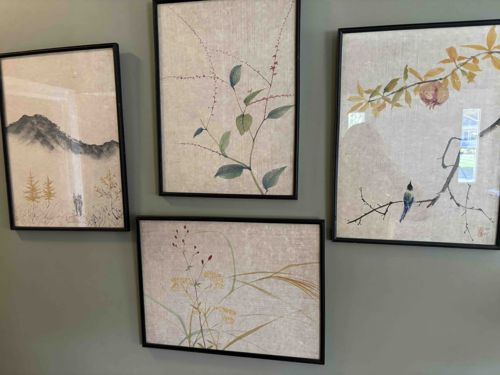
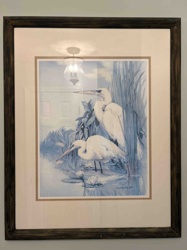
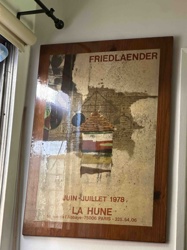
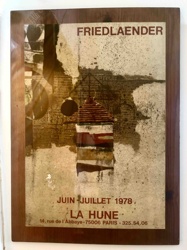
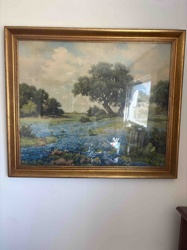
This is a set of four framed art prints, each depicting a different scene in a style reminiscent of traditional Japanese ink wash painting (Sumi-e) or East Asian botanical illustration. The prints are housed in simple, slender black frames, suggesting a modern or minimalist aesthetic for display.
Each print features a light, possibly linen-textured or rice paper-like background in off-white or very light beige, providing a soft canvas for the delicate illustrations. The coloration is muted, predominantly featuring soft greens, grays, browns, and ochre yellow, with occasional touches of blues and deeper earth tones, characteristic of natural pigments.
The top-left print portrays a serene mountain landscape with a misty or cloudy atmosphere, featuring dark, jagged peaks and lighter, more ethereal slopes in the background. In the foreground, there are sparse trees, some with yellowed foliage, and two small figures appearing to walk through the landscape, suggesting depth and human scale.
The top-right print showcases a branch with broad, yellow-green leaves and what appears to be a ripening pomegranate fruit, suggesting an autumn or late summer scene. Below the branch, a small blue bird with a dark head is perched on a thinner branch, adding a focal point and a touch of vibrant color.
The bottom-left print (from the original image) is oriented vertically and depicts a plant with small, reddish-pink flowers or berries and delicate green leaves, possibly a form of wild berry or flowering vine.
The bottom-right print (from the original image) is horizontally oriented and features an intricate drawing of various grasses and wildflowers, with some stalks bearing seed heads or subtle yellow blossoms, conveying a sense of gentle movement and natural beauty.
The frames are consistent in style and size, appearing to be made of wood or a composite material with a matte black finish. The artwork is protected by a clear glazing, likely glass or acrylic, which exhibits some reflections from the surrounding room, indicating its transparency. There are no obvious visible condition issues like significant wear or damage to the frames or the prints themselves, however, the clarity of distinguishing fine details or artist signatures is limited due to the image resolution and angle. The style suggests a contemporary production, likely intended for decorative purposes in a home or office setting, evoking a calm and natural ambiance. The craftsmanship appears clean and professional, with a focus on simplicity and elegance.
AI Appraisal Report
I have examined the provided image of the Set of Four Framed Japanese-Style Ink Wash Art Prints. Based on visual inspection, the overall condition appears to be excellent; the frames show no obvious wear, and the prints themselves are clean and well-preserved behind glazing. There are no visible condition issues such as tears, fading, or significant scuffs.
Authenticity, in terms of being true traditional Japanese Sumi-e or antique prints, is unlikely. The style, framing, and overall presentation strongly suggest contemporary decorative prints designed to evoke a modern, minimalist aesthetic. While the art style is reminiscent of traditional East Asian techniques, the clean lines, uniform framing, and lack of visible artist's seals or individual hand-painted variations indicate they are most likely mass-produced reproductions or prints rather than original works by a recognized artist.
Market conditions for such decorative art are primarily driven by aesthetic appeal and current home decor trends. Comparable items, typically new framed prints of similar size and style found in home goods stores or online retailers, range from $30-$70 per print, making a set of four fall within the $120-$280 range. Demand for aesthetically pleasing, ready-to-hang art like this is consistent, particularly for styles that evoke calm and nature. Rarity is not a factor here, as these are almost certainly widely available reproductions.
The primary factors impacting value are their decorative appeal and good condition. The lack of an artist's signature, edition number, or provenance significantly limits their value as fine art.
For full authentication of these as original artworks or prints by a specific artist, an in-person examination would be critical to inspect paper type, print method (e.g., giclée vs. woodblock), and look for any hidden signatures or chop marks. Provenance documentation, such as certificates of authenticity or artist biographies, would also be essential for verifying their origin and artistic merit. Without these, I must conclude they are decorative prints with value primarily in their aesthetic contribution to a space.