AI estimate as of August 9, 2025 · verify with a professional before acting
AI-Generated · Verify before acting
Everything on this page is generated by AI for informational purposes only. AI can make mistakes — the AI may misidentify items or misattribute them (artist, maker, brand, designer, origin, era). This is not an official valuation and should not be used for insurance, sale, tax, estate, legal, or lending purposes — or any decision requiring a certified appraisal. It is not an authoritative claim about any person, brand, or rights holder — do not share or rely on it as a factual statement about a third party. Always consult qualified professionals before making financial decisions.
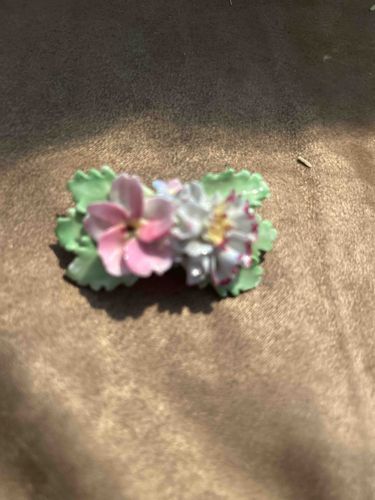
This item is a small, decorative ceramic or porcelain floral cluster. It features two prominent flowers, one primarily pink and the other predominantly white with pink accents, set against a backdrop of green leaves. The pink flower has multiple petals, appearing to be an open bloom, with a subtle yellow or cream center. The white flower, positioned to the right of the pink one, also exhibits multiple layers of petals, with a more pronounced yellow pistil or stamens at its center, rimmed with pink. The green leaves are sculpted with characteristic veining and serrated edges, suggesting a naturalistic representation. The overall construction appears delicate, consistent with handcrafted or molded ceramic work. Given its size and detailed craftsmanship, it is likely intended as a decorative accent, such as a brooch, a dresser ornament, or part of a larger floral arrangement. The resolution of the image makes it difficult to discern specific manufacturing marks or the exact condition of the delicate petals, but no obvious chips or cracks are visible from this vantage point. The style suggests a mid-20th century to contemporary period, often found in 'finer' porcelain lines. The glazing appears lustrous, indicating a typical ceramic finish.
AI Appraisal Report
Based on my visual examination of the provided image, this porcelain floral cluster is a charming decorative accessory. The craftsmanship appears delicate, with well-sculpted petals and leaves, and the glazing shows a pleasing luster. The condition, from what I can discern, appears good; I don't observe any overt chips, cracks, or repairs, which is crucial for such fragile items. However, without a physical inspection, minor flea bites, hairline cracks, or previous repairs are impossible to definitively rule out. Authenticity, based solely on an image, is also limited; without maker's marks or provenance, attribution to a specific manufacturer or period remains speculative. The style suggests a mid-20th century to contemporary production, often seen in mass-produced decorative porcelain.
In terms of market conditions, items like this floral cluster generally fall into the broader category of decorative arts. While there's a steady demand for well-crafted porcelain, individual pieces like this, without significant provenance, a renowned maker, or exceptional rarity, typically command modest prices. Comparables I've seen in online auctions and antique shops for similar unmarked porcelain flower clusters range from $20 to $60. Rarity is low; many such pieces were produced. Factors impacting value positively would be a recognized maker's mark (e.g., Dresden, Capodimonte), perfect condition, or historical provenance.
For full authentication and a more precise valuation, I would need a direct physical examination to check for maker's marks, assess the true condition, analyze the porcelain body and glazes for age indicators, and potentially conduct blacklight testing for repairs. Provenance documentation, if available, would also be invaluable.