These notes were written by the person who submitted this item. Appraiser.AI has not verified them, and the AI's identification and estimate may rely on them.
AI Estimated Value
Not an official valuation
$1,800 - $2,500
AI estimate as of July 2, 2025 · verify with a professional before acting
AI-Generated · Verify before acting
Everything on this page is generated by AI for informational purposes only. AI can make mistakes — the AI may misidentify items or misattribute them (artist, maker, brand, designer, origin, era). This is not an official valuation and should not be used for insurance, sale, tax, estate, legal, or lending purposes — or any decision requiring a certified appraisal. It is not an authoritative claim about any person, brand, or rights holder — do not share or rely on it as a factual statement about a third party. Always consult qualified professionals before making financial decisions.
This analysis also relies on unverified notes provided by the user, which may be incomplete or inaccurate and could affect the result.
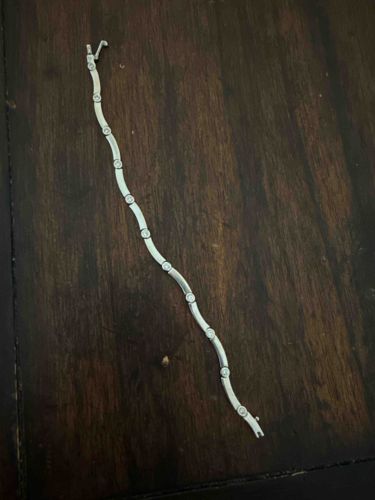
The item is a white gold and diamond tennis bracelet, distinctly characterized by its undulating, wave-like links rather than the traditional straight line. The bracelet appears to be approximately 7 to 7.5 inches in length, a standard size for a ladies' wrist. It is crafted from a polished white metal, consistent with white gold as per the provided context, which displays a bright, reflective surface. The links are connected by small, almost invisible hinges, allowing the bracelet to articulate fluidly. Each curved segment of the white gold band features a single, bezel-set round diamond. There are approximately 10 to 12 diamonds visible in the image, evenly spaced along the length of the bracelet. The diamonds are round brilliant cuts, appearing clear and well-faceted. The bezel settings encircle each diamond completely, providing a secure mount and a smooth finish, which contributes to a contemporary aesthetic. The clasp mechanism on one end appears to be a traditional hook or tongue-and-groove style, designed for secure fastening. No obvious damage, such as bent links or missing stones, is discernible from the image, suggesting good overall condition. There might be minor surface scratches consistent with normal wear, but no significant wear or repair is apparent. The craftsmanship appears to be of good quality, with cleanly set stones and smoothly finished metalwork. The unique wavy design suggests a modern or contemporary style, likely from the late 20th or early 21st century.
AI Appraisal Report
Based on my visual examination of the provided image, this white gold and diamond wavy link tennis bracelet is a distinctive piece of jewelry. Its condition appears to be good, with no obvious damage such as bent links or missing stones. The polished white metal, consistent with white gold, retains a bright, reflective surface, indicating proper care. The bezel settings for each round brilliant cut diamond appear secure and smoothly finished, contributing to its modern aesthetic. The diamonds themselves appear clear and well-faceted.
In terms of market conditions, tennis bracelets, particularly those with unique designs, maintain consistent demand. The wavy link design offers a contemporary appeal over traditional straight-line bracelets, potentially attracting a buyer seeking something less conventional. However, the bezel setting, while secure, can sometimes make diamonds appear smaller than prong settings, a factor that can subtly influence value. The quality of craftsmanship appears good, with clean stone setting and finished metalwork.
Factors significantly impacting value include the carat weight of the diamonds (which cannot be precisely determined from the image), the specific purity of the white gold (e.g., 14k vs. 18k), and the precise number and quality (color, clarity, cut) of each diamond. Without knowing these specifications, the appraisal is based on general visual assessment.
It is crucial to note the limitations of appraising from images alone. Full authentication requires an in-person examination. This would involve verifying the metal type and purity through testing, precisely weighing and measuring each diamond for accurate carat weight, and assessing their individual color, clarity, and cut grades under magnification. Provenance documentation, such as original purchase receipts or diamond grading reports (e.g., GIA, AGS), would also be invaluable for confirming authenticity and quality.