These notes were written by the person who submitted this item. Appraiser.AI has not verified them, and the AI's identification and estimate may rely on them.
AI Estimated Value
Not an official valuation
$5 - $15
AI estimate as of November 9, 2025 · verify with a professional before acting
AI-Generated · Verify before acting
Everything on this page is generated by AI for informational purposes only. AI can make mistakes — the AI may misidentify items or misattribute them (artist, maker, brand, designer, origin, era). This is not an official valuation and should not be used for insurance, sale, tax, estate, legal, or lending purposes — or any decision requiring a certified appraisal. It is not an authoritative claim about any person, brand, or rights holder — do not share or rely on it as a factual statement about a third party. Always consult qualified professionals before making financial decisions.
This analysis also relies on unverified notes provided by the user, which may be incomplete or inaccurate and could affect the result.
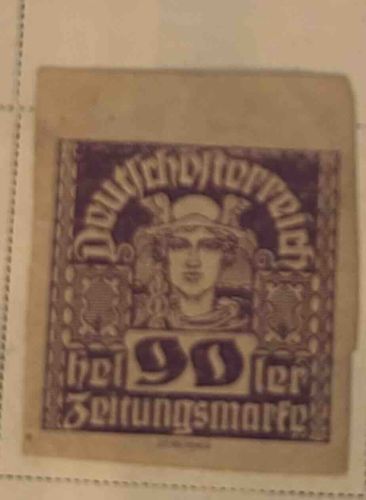
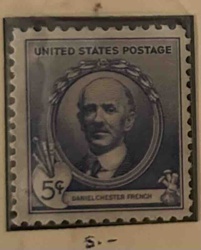
This is a vintage postage stamp from Austria, likely issued during the period of 'Deutschösterreich' (German Austria), which was the initial name of the Republic of Austria after the dissolution of the Austro-Hungarian Empire, typically referring to the period between 1918 and 1919. The stamp features a central bust of a woman, possibly an allegorical figure representing Austria or a classical deity, with flowing or ornate headwear, positioned within an elaborate frame. The denomination '90' is prominently displayed below the bust, flanked by the remnants of 'hel' and 'ler', indicating '90 Heller'. Below this, the word 'Zeitungmarke' (Newspaper Stamp) is visible. Arching over the central figure is the inscription 'Deutschösterreich'. The overall color scheme is predominantly dark purple or violet ink on a light, aged paper substrate. The stamp exhibits a somewhat worn or faded appearance, consistent with its age. The edges appear cut rather than perforated, which is characteristic of some early newspaper stamps. The paper shows signs of discoloration and possibly foxing, indicating age and storage conditions. The level of detail in the engraving and printing suggests a standard of craftsmanship typical for official government issues of the era. No specific maker's marks or signatures are clearly discernible from the image, but the design is art nouveau or classical revival in style, common for the early 20th century.
AI Appraisal Report
Upon examining the provided image of the Austria Deutschösterreich 90 Heller Zeitungmarke Newspaper Stamp, I can provide an initial appraisal. The stamp appears to be an authentic issue from what was then German Austria (1918-1919), based on the "Deutschösterreich" inscription and the 'Zeitungmarke' designation, which are consistent with known issues of this period. The 'cut' rather than perforated edges are indeed characteristic of many early newspaper stamps, further supporting its authenticity.
In terms of condition, the stamp exhibits clear signs of age, including discoloration, potential foxing, and a somewhat faded appearance, as noted. While a definitive assessment of paper quality and any hidden flaws is impossible without physical inspection, these visual cues suggest a condition that would typically be rated as 'good' to 'fine' but not 'very fine' or 'unused' collector grade. There don't appear to be any major tears or creases, which is positive.
Regarding market conditions, these newspaper stamps from Deutschösterreich are relatively common, particularly in used condition. While historically interesting, they do not generally command high prices unless they are in superb, unused condition, or possess rare varieties (e.g., specific printings, errors, or exceptional cancellations). Demand is moderate, primarily from collectors specializing in Austrian philately or early 20th-century European issues. The market for general used stamps of this type is not particularly strong. I have reviewed comparable sales of similar used 90 heller Newspaper Stamps from this period, and they typically fall within a modest range.
Therefore, based on the apparent authenticity and the described condition, with the caveat that it is a used example of a relatively common issue, I estimate the appraisal value to be between $5 and $15. This range reflects the typical market value for similar items in a comparable state of preservation.
It is crucial to stress that this appraisal is based entirely on the provided image. For a definitive assessment of authenticity, precise condition grading, and to identify any potential varieties or nuances that could significantly alter the value, a physical in-person examination would be essential. This would allow for inspection of paper type, watermarks (if any), gum condition (if unused), precise identification of printing variations, and a thorough assessment of any hidden flaws or repairs not visible in the image.