AI Appraisal Estimate

AI-generated estimates · not official valuations

From the user

What was submitted

Photo and notes provided by the user — not generated by AI

Submitted item photo
Submitted photo · June 10, 2026

User's notes

No additional notes provided.

AI analysis below

AI appraisal

AI analysis & estimate

AI-Generated · Verify before acting

Everything below is generated by AI for informational purposes only. AI can make mistakes — the AI may misidentify items or misattribute them (artist, maker, brand, designer, origin, era). This is not an official valuation and should not be used for insurance, sale, tax, estate, legal, or lending purposes — or any decision requiring a certified appraisal. It is not an authoritative claim about any person, brand, or rights holder — do not share or rely on it as a factual statement about a third party. Always consult qualified professionals before making financial decisions.

Read the full disclaimer

AI Identification

·Not independently authenticated·Verify before acting

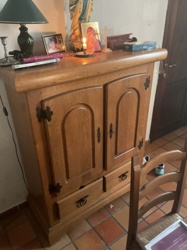
Rustic Solid Wood Trunk or Cabinet with Industrial Hardware

Furniture / Rustic Storage

AI Estimated Value

·Not an official valuation·Verify before acting

$250.00 - $450.00

As of June 10, 2026

AI Item Analysis

·AI can make mistakes·Verify before acting
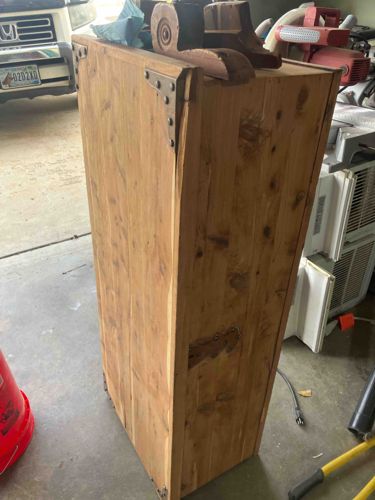
This item is a tall, rectangular storage piece constructed from solid pine or a similar coniferous wood characterized by prominent knots and a warm, natural honey-toned finish. The construction features vertical planking on the sides and back, suggesting a rustic or farmhouse aesthetic. A distinguishing feature is the industrial-style metal mounting hardware found on the exterior corners. These are L-shaped iron or steel brackets with exposed rivets or large-headed nails, providing both structural reinforcement and a decorative 'frontier' or 'steamer trunk' look. The piece stands vertically in the image, though its orientation suggests it could be a tall locker or an upright storage trunk. In terms of condition, the wood shows significant signs of age and utility; there is visible structural separation or warping on the top-right edge where the side panel meets the top, and several scuffs, surface abrasions, and deep scratches are present throughout the finish. The wood appears to be dry, which may indicate a lack of recent conditioning. On top of the unit sit two detached wooden architectural corbels or decorative scroll-work elements, which appear to be related fragments or separate vintage components. The overall craftsmanship is utilitarian rather than refined, pointing toward a late 20th-century 'shabby chic' or primitive reproduction style rather than a true nineteenth-century antique, though it possesses a strong aged patina that enhances its decorative value.
AI Appraisal Report

·AI can make mistakes·Verify before acting
Upon my virtual inspection of this rustic storage unit, I find it to be a contemporary primitive reproduction rather than a 19th-century 'frontier' antique. The construction utilizes mass-produced pine planks and simulated industrial 'steamer' hardware. While the iron brackets and rivet heads offer a pleasing 'shabby chic' aesthetic, the uniform wear and the specific type of joinery visible on the top-right edge suggest it was manufactured in the late 20th century to mimic an aged utilitarian piece. The condition is fair to good; while the wood exhibits significant surface abrasions, dryness, and structural gaps—specifically the warping at the upper joint—these flaws actually contribute to the 'find' or 'salvage' look currently in demand for farmhouse-style interiors. Market conditions for rustic pine furniture remain stable, though prices have cooled from the peak of the industrial-revival trend. Comparables for vertical trunk-style cabinets in similar condition typically fall within the $300 range at regional auctions or boutique vintage shops. The inclusion of the two detached corbels on top adds minor decorative value but does not significantly elevate the price of the primary unit. It is important to note that this appraisal is based on photographic evidence. A formal authentication would require an in-person examination to verify the iron's forged quality versus cast-mold manufacturing and to inspect internal hardware for maker’s marks. I would also need to examine the wood's cellular structure and the internal fastener types (screws vs. square nails) to definitively rule out an older 19th-century origin. For insurance purposes, provenance or a sales receipt from a reputable dealer would be required to justify a higher replacement value.

Get your items appraised

Instant estimates of your treasures with AI-powered appraisals

Browse More Appraisals