AI estimate as of October 8, 2025 · verify with a professional before acting
AI-Generated · Verify before acting
Everything on this page is generated by AI for informational purposes only. AI can make mistakes — the AI may misidentify items or misattribute them (artist, maker, brand, designer, origin, era). This is not an official valuation and should not be used for insurance, sale, tax, estate, legal, or lending purposes — or any decision requiring a certified appraisal. It is not an authoritative claim about any person, brand, or rights holder — do not share or rely on it as a factual statement about a third party. Always consult qualified professionals before making financial decisions.
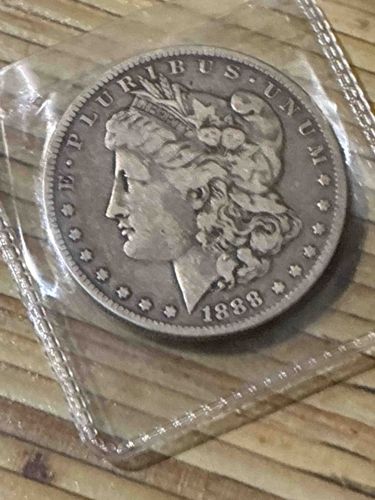
This item is an 1888 Morgan Silver Dollar, an iconic piece of American numismatic history. The coin is presented in a clear, soft plastic protective sleeve, which suggests it is being preserved by a collector. The obverse side of the coin is clearly visible, featuring the left-facing profile of Lady Liberty, often referred to as the 'Morgan Head'. Her hair is intricately styled, flowing backwards with noticeable curls and tendrils. She wears a Phrygian cap adorned with the word 'LIBERTY' and a wreath of cotton and wheat, symbolizing American agriculture and industry. Above her head, along the rim, the motto 'E PLURIBUS UNUM' is inscribed. The lower portion of the design clearly displays the minting year, '1888'. Surrounding the central design and the inscription are 13 stars, representing the original thirteen colonies. The coin appears to be made of silver, exhibiting the typical gray-white luster and some signs of natural toning or patina, consistent with its age. While a precise grade cannot be determined from the image, the details on Liberty's face and hair are largely intact, indicating that the coin is in at least a 'Fine' to 'Very Fine' condition, with moderate wear visible on the highest points of the relief. There are no obvious deep scratches, gashes, or significant environmental damage visible, although some light surface marks consistent with handling and circulation over a century can be discerned. The specific design points, such as the clarity of the date and the lettering, suggest a well-struck coin for its era. The craftsmanship is typical of U.S. Mint coinage of the late 19th century, known for its detailed engravings. No specific mint mark is visible in the provided image, which would typically be located on the reverse side below the eagle, or potentially not present if minted in Philadelphia. The coin belongs to the late 19th-century American coinage style period.
AI Appraisal Report
I have examined the provided image of this 1888 Morgan Silver Dollar. Based on the visual evidence, the coin appears to be authentic, exhibiting the characteristic design and details for this year and type. The obverse displays clear features of Lady Liberty, with 'E PLURIBUS UNUM' and '1888' legibly inscribed. The presence of 13 stars and the overall craftsmanship are consistent with U.S. Mint coinage of the late 19th century.
Regarding condition, the coin shows moderate wear on the high points of the relief, such as Liberty's hair and the cap details. However, significant details remain largely intact, suggesting a grade in the 'Fine' to 'Very Fine' range (F-12 to VF-30). There are no deep scratches or gashes, but light surface marks consistent with circulation and handling over its lifespan are discernible. The natural toning or patina is expected for a coin of this age. Without seeing the reverse for a mint mark, it's assumed to be a Philadelphia mint issue, which typically has no mint mark.
The market for common date Morgan Dollars, such as the 1888, is robust but largely driven by condition. Coins in the Fine to Very Fine range are plentiful. Demand is steady from both collectors and investors in silver. Rarity for this specific date and assumed mint is low in circulated grades. The primary factor impacting value here is the circulated condition. A full appraisal would require a physical examination to accurately grade the coin, confirm authenticity with certainty (including metal content), and identify any subtle imperfections not visible in the image. I would also need to examine the reverse for a mint mark or additional wear. For definitive authentication and grading, submission to a third-party grading service (e.g., PCGS, NGC) is recommended.