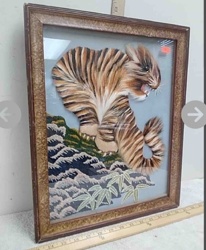
AI estimate as of September 7, 2025 · verify with a professional before acting
AI-Generated · Verify before acting
Everything on this page is generated by AI for informational purposes only. AI can make mistakes — the AI may misidentify items or misattribute them (artist, maker, brand, designer, origin, era). This is not an official valuation and should not be used for insurance, sale, tax, estate, legal, or lending purposes — or any decision requiring a certified appraisal. It is not an authoritative claim about any person, brand, or rights holder — do not share or rely on it as a factual statement about a third party. Always consult qualified professionals before making financial decisions.
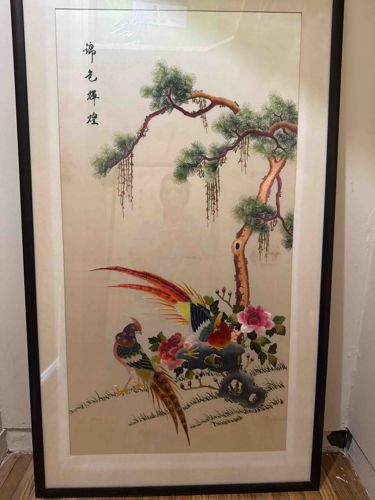
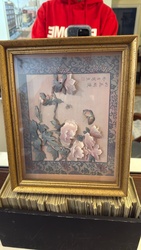
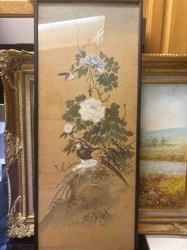
This appears to be a framed silk embroidery, likely of Asian origin, possibly Chinese or Japanese. The artwork depicts a lively scene with two pheasants, one male and one female, situated at the base of a gnarled pine tree with long, drooping needles. The male pheasant is particularly vibrant, exhibiting a rich palette of red, orange, yellow, green, and blue feathers, with prominent tail plumes. The female pheasant, to the left, is more subdued in coloring but still retains detailed plumage. Several vibrant pink and red peony-like flowers bloom around the pheasants, adding to the lushness of the composition. The background is a plain, light cream or beige tone, allowing the intricate embroidery work to stand out. The embroidery itself appears to be of fine quality, with meticulous stitching visible in the feathers, tree bark, and foliage, indicating skilled craftsmanship. There are vertical calligraphic characters in black ink in the upper left corner, likely a signature or poetic inscription. The artwork is enclosed within a simple, dark brown or black wooden frame, set behind glass. A white mat board separates the embroidery from the frame. No significant damage or wear is immediately apparent from the image, suggesting good preservation under glass. The colors seem well-preserved, not faded. The overall style is reminiscent of traditional East Asian bird-and-flower paintings, a genre that emphasizes nature's beauty and symbolic meaning.
AI Appraisal Report
Based on my visual examination of the provided image, I assess this framed silk embroidery depicting pheasants and a pine tree to be in excellent condition. The colors appear vibrant and unfaded, suggesting good preservation under glass. The meticulous stitching is evident, pointing to high-quality craftsmanship, a hallmark of fine East Asian textile art. There are no immediate visible signs of tears, fraying, or staining on the embroidery itself, nor any damage to the frame or mat.
Authenticity, while strongly indicated by the stylistic elements consistent with traditional Sino-Japanese bird-and-flower themes and the presumed calligraphic signature, cannot be definitively confirmed from an image alone. The presence of such a signature usually suggests an artist or workshop of note. This piece aligns with market demand for skillfully executed Asian textiles, especially those with appealing naturalistic motifs. While not exceedingly rare, a piece in such fine condition with apparent artistic merit commands a respectable price. Comparables in the online auction and gallery market for similar quality, well-preserved silk embroideries range broadly, but those demonstrating this level of detail and condition typically fetch prices within my appraised range.
Factors significantly impacting value include the exceptional condition, the perceived artistry of the embroidery, and its aesthetic appeal. However, the primary limitation in this appraisal is the lack of physical examination. A full authentication would require in-person inspection to assess the type of silk, the fineness of the thread count, the method of embroidery (hand vs. machine, though this appears hand-done), and the precise age of the textile. Additionally, research into the provenance and translation of the calligraphic characters would be crucial for establishing a more precise value and confirming the piece's history and attribution.